Showing posts with label book review. Show all posts

Sunday, October 1, 2017

October 2017 Blogcation (RAEBNC Halloween Kitties)

It is October, and that means that there is a fifty percent chance that this blog is going to suffer a Blogcation. And the theme of this year's Halloween Kitties is RAEBNC.

What is RAEBNC? Glad you asked.

RAEBNC is a short way of saying, "Read And Enjoyed, But No Comment."

It is something that one would often read in Amateur Press Associations zines. It was used for those times where you read something, enjoyed it, but really could not be bothered to come up with a thoughtful comment.

Kinda like the reaction buttons on Facebook. Or the Love button on Facebook (but with less get-up-and-go).

And there are days when I so want to use RAEBNC on Facebook. But that would involve actually explaining the term...which would be more effort than I would like to make. Still it could be a fun thing to do, especially if I did not have to explain it. Just drop it in multiple discussions.

For instance...

"I am the most powerful magician in the world, chosen by the Secret Chiefs to lead the world into a new age of spiritual freedom!!!" [Pretend that this goes on for another thousand words.]

Just drop RAEBNC in the comment/reply section and move on with your day. What is the worst that can happen? They defriend you? They ban and block you? Sounds like a winning day to me.

So this entire month is going to be devoted to cats in costumes (or not) and strange replies you could just drop into comment sections to amuse yourself. Or me. Or both of us. Long live chaos!

I would comment, but I am too busy cosplaying in this bucket.

Monday, July 18, 2016

C is for Cthulhu

As someone who writes about Cthulhu...ok, pretends to write about Cthulhu (because we all know that I only pretend to exist and to be a writer to disguise the fact that I am really a hideous trolly sock invented by my friend, eh master, or is that mistress?...hand?...foot? [I am so confused], invented by the marvelous Ms. Mitzy for the sole purpose of annoying the Imperial Pickle), as such an imposter, I try to keep my eye(s) open for new and exciting Cthulhu stories and products.

And one such item that I have stumbled upon is a children board book called C is for Cthulhu (The Lovecraft Alphabet Book) written by Jason Ciaramella with artwork done by Greg Murphy.


Yes, a whole book with big letters, and cute eldritch pictures of things that will cause you to lose your sanity someday. After all, someone has to teach the little ones that are things in the universe that will wake up when the stars are right, and end us all....unfortunately, probably not until some time after Trump starts his third term and when only white folks with loaded assault rifles and absolutely no fresh produce remain in 'Murica. C'mon Cthulhu (or Killer Asteroid)--let get this show on the road and save us from the far worse insanity that the next great worst President will bring.

(And if you fear Hillary...yeah, she too will be the very worst thing to happen to the United States. And Cthulhu is not going to show up until after the big bank buffet that will eat the flesh from your bones and make you homeless and generally unpopular with employers.)

[I would proceed to cover my rear, and claim that Bernie is going to be the worst President, but....*sigh*---have I mentioned that this election cycle required several sanity rolls?]

Now, I am not sure what age group that this book is aimed at. The children seen with this book are about the size of small pumpkins---yes, I know that is completely non-helpful, but what do you expect from someone that decided to only have children with four legs and fur? Though as a completely fictitious person, I could claim to have thousands of children, and millions of fans and readers, who I generously buy Snickers bars for. I mean, you would never know because as a figment of someone's imagination, there is absolutely no chance that you will run into me at the grocery store to actually see what I buy. A million Snickers bars? A couple big bags of cat food? You don't know. It is my word as a sock versus the completely honest words of the world's greatest pickle.

This is my favorite page from C is for Cthulhu.
The book is also seen with adults, who seem like the type of people who think that it is jolly good fun to make their children make sanity rolls at an early age. And not just for witnessing the horrific illustration of Cthulhu, but also some of his friends like Shoggoth and the Black Goat of the Woods....and this kinda sounds like one of those afternoon cartoons from the 80s and 90s---Cthulhu and Friends!!!....and I really want to see it while enjoying a Scooby snack or two...well, except as a sock, I don't actually eat---I only bad-mouth the glories of guns and the greatness of the only political candidate that the Imperial Pickle approves of. (What more proof do you need that I am nothing more than just a nasty sock?! A signed affidavit written in blood and pickle juice?)
And I so want one of these!!!!
There is also some marvelous plushes of Cthulhu. My favorite is the purple one, and someone really needs to buy one for me and send it to my address--2727 Cook St. Denver, CO 80205---it does not matter that I am imaginary and only a sock---I want a toy!

What? No? What do you mean that you think that this entire post was just a trick to try to get someone to buy me a purple Cthulhu plush? Seriously, I would also accept a green or red Cthulhu plush if someone loved me enough to buy one for me. After all, it is not like you have any other imaginary friends to shop for. Buy me a toy--dammnit!!!! Don't listen to the Imperial Pickle when he says that I have been a very naughty boy and have no clue about the really important things in life. I know important things when I see them---and their name is Cthulhu plushies!

So if you really love me, head over to the C is for Cthulhu website, and buy me a plush. Or if you must, one for yourself---just don't let your kids see it because they will want to have it instead.

Thursday, July 2, 2015

Unpacking the Hermetic Tablet Summer 2015

And welcome to a delightful video of me hopping onto the Unpacking Bandwagon while losing my cotton picking mind--ending up with me reviewing the entire Hermetic Tablet (Summer 2015 issue) without ever reading it...because that is how all occult books are reviewed, right?


Thursday, April 30, 2015

Flash review of Liber L vel Bogus

Today, I received my review copy of Liber L. vel Bogus--The Real Confession of Aleister Crowley (Richard T. Cole).  The basic premise of the book is that Crowley faked the receivership of the Book of the Law. And here is a flash review of the book that I posted to YouTube.


Thursday, January 15, 2015

Would I still give the Ritual Magic Manual three stars?

Last night, on one of the Golden Dawn Facebook groups, David Griffin's book, The Ritual Magic Manual, came up during a discussion. I had reviewed this book back in March 2009 when I was doing the "page view" sites (basically, you wrote articles and got paid by the number of page views that the article generated). The review ended up on three sites---it was one of my test articles to see what site was getting the most traffic, and was giving out the best payment.


At the time, I gave The Ritual Magic Manual "two or three stars." If the sites would have required a solid decision (like Amazon does), at the time, I would have given it three stars (rounding up). David Griffin promptly took issue with the fact that I reviewed his book. Being an out of print book, he thought that it should not be reviewed. Why did I review it? Well, David Griffin started to brag that it was selling for a thousand dollars in the used market, which in my mind made it "review worthy."


A question came up last night that prompted this post today. Someone asked how the printing and binding quality of the book was. Honestly, I seen worse, and I have seen better. It was basically the average for the time period. The pages are stitched---looks like machine work. I didn't use my copy a whole lot, having came from a Temple culture that required you to memorize the rituals that you were doing---but I think that the book would have held up to the abuse of daily use.


Is it worth a thousand dollars? Hell, no. But then again, I have never seen an out of print occult book that I thought was worth a thousand. I do know that following the occasional eBay auction and the listings on Amazon that I have never see a copy move for that price. And personally, no one has offered me loads of money to part with my copy....which makes me believe that the true market value is much lower than the thousand dollars I see in the listings.


If you really want a copy of the book, just ask David Griffin. A few years ago, someone scanned the book into a PDF, and Griffin will give a copy of it to anyone that asks him for it. (I do not know who made the PDF, but I know that it was not Griffin---it is a scan, not a conversion from the original files.)


[If anyone wants to read the original review, it is archived on my inactive book review blog---the sites that the review was originally on have dropped off the internet.]


So would I still give it three stars? Probably not. Today, it would probably be two stars---I honestly do not agree with the premise of the book, and was taught that swapping godforms multiple times during a ritual to be dangerous. I still believe that you should memorize the rituals you are using, and should be able to work out the variations on your own.


Of course, you do not need to take my opinion on this book. Griffin will give a copy of the PDF to anyone who asks for it.


And just so you know, Griffin as a writer, does not benefit one dime from the used sales of his book---so do not think that you are somehow robbing him by not buying an used copy of the book.

Wednesday, June 18, 2014

Crata Repoa Decoded by Nick Farrell (book review)

As most of my regular readers know, the latest limited edition offering by Nick Farrell is The Hidden Path Behind Initiation or Crata Repoa Decoded. In the book, Farrell comments on the "syncretic fantasy" of masonic ritual, the Crata Repoa, written in 1770 by Karl Friedrich von Koppen and Johann Wilhelm Bernhard von Hymmen. Treating the Crata Repoa as an allegory of initiation, Farrell teases out a general path that all initiates of spirtual traditions suffer though.

And it is a path of darkness and suffering, with a lot of death and underworld experiences, if Farrell's reading of the allegory is correct. This is a point that I am currently hard pressed to argue with, given both my depression and the fact that I feel as if my connection to the higher has dried up (my depression probably would not be as bad as it is if I felt that I was still under the blessing of the higher, but that ship has sailed). Given my personal state of mind, I am not so sure that I can do justice in reviewing this book, still one must try.

One of the amusing things that has occurred since Farrell has published this book, or I assume that it would be amusing if my mental state was close to normal, is that Farrell recieved a "cease and desist" notice from someone claiming that Farrell had revealed real secrets about an Order constructed from the Crata Repoa. Personally, I do not see how he could have revealed real secrets unless the Crata Repoa itself is being considered a secret, for the majority of the book is his own reading of the allegory.

This is not a book that you buy to learn the secrets of another group--this is a book that you read to learn something about the secrets of the group that you already belong to. In my case, that would be an offshoot of the Golden Dawn tradition, and not any group based on the Crata Repoa itself.

One of the theories that occultists have is that the path of initiation, especially the mystical and magical versions, has certain landmarks, no matter what version that one suffers though. And Farrell theoricizes that this is exactly what the allegory is supposed to be about, the common experiences that initiation would bring about. After reading the book, I must admit that Farrell seems to be right that the Crata Repoa was an allegory to talk about these spiritual experiences.

Farrell also points out places where the Crata Repoa might have influenced the creator of the Golden Dawn Cipher Manuscript, in particular the use of the names of certain officers of the Order.

Normally, at this point, I would give a star rating to the book, but honestly I am not sure that I can do that with complete clarity, so I will not attempt to do so. Do I think that the book is worthwhile to my readers? To some of them, yes--but I am not sure that my entire audience would benefit from reading this book, especially if they are not yet ready to start to struggle with the overall arch that the path of initiation entails.

Tuesday, April 15, 2014

The Magic Machine by Nick Farrell (book review)

One of the things that amuses me is the occasional outpouring of "secrets must be kept" when someone dares to publish something that is already well past its "keep secret until" date. Today, the source of my amusement was the debate on whether or not, Nick Farrell should have published pictures of the walls of the Vault of the Adepts.

My own position...well let's see...

Venus Vault Wall Study.
...I first published a set of Vault wall studies on this blog starting in June 2009, shortly after the Book of the Tomb was open-sourced by Nick Farrell. And I have kicked around actually doing some Vault wall merchandise...something that I may still do. After all, a quick image search on Google will yield dozens of hits, and there are some crass people already doing Rose Cross lamen merchandise (all seem to be using the same picture to boot). So I really think that secrecy on this particular subject has flown the coop. It is now time to start making sure that people are getting it right. Now that my position on secrecy and much of it still apllies to the Vault walls is out of the way, let's move on to reviewing the book in question.

As I have already said, secrecy has flown the coop on this one--it is time to make sure that people are getting it right. And this is what The Magic Machine--The Golden Dawn Vault in Colour by Nick Farrell is about, helping people get the vault colors right.

The most valuable piece of this book is the eight colored plates showing the general key to the background color of the Vault walls, and the individual planetary Vault walls. And while I prefer mixed pigments over pixels, I wish I would had this book earlier in my occult career when I was preparing to build a Vault of the Adepts.

(Before you ask, the project never got past the study stage, due to the sudden vacating of anyone who might have needed to be vaulted by the current lodge that I belong to...it was a strange summer that year.)

Comparing my first study and later ones (I have done several over the years) to the plates in The Magic Machine, I am comforted to see that I am in the general ballpark, not exactly the same colors as Farrell is using, but close enough when one accounts for the difference in methods used. It was also comforting to read that someone else stumbled upon the problem with the Vault's ceiling--something that drives me a little batty.

Now I imagine that some people in the Golden Dawn tradition will claim that he is wrong about how the colors are created. Of course, if he is wrong, then so am I--and I was initially working from the texts published by Regardie and some misc. unpublished notes from a modern Order, and not directly from the Book of the Tomb. Then again, I just shake my head about how the critics have done their own Vaults--it is like they are working from a completely different set of instructions that have nothing to do with any actual Golden Dawn material.

Besides the meat of the book, Farrell does give hints on how to use the pictures, general information about the Vault of the Adepts, and a nice set of planetary deity calls to key your work with the Vault walls to.

I recommend getting this book if you ever think that you might need to build a Vault or work with one.

Five out of five stars.

The Magic Machine--The Golden Dawn Vault in Colour is a limited edition hard-cover book available from Lulu. 

[Required FTC disclosure: This review was based on a low res electronic copy of the book given to the reviewer to ensure a timely review of the book.]

Sunday, February 16, 2014

The Shem Grimoire by Nick Farrell (Book Review)

Table of contents page from the Shem Grimoire.
The first thing that a reader needs to know about this book is that this book is not for beginners. This is not a history of the Shem ha-Mephorash and the evolution of its associated angels, nor is it heavy on theory and philosophy. No, this is a grimoire with just enough history and theory to orient a Zelator Adept Minor (Z.A.M.) before turning them loose on actual working with the Shem Angels.

The second thing that a reader needs to know about this book is that it is meant to be used. One of its center pieces is a ritual to actually get in contact with a Shem angel (one of the 72 angels created from the so-called 72 lettered name of God...which actually has 216 letters in it, but who is counting?). There is also an interesting Middle Pillar ritual, complete with head movements inspired by Abraham Abulafia (a mystic of the Kabbalah bent).

(I might write a blog entry about the rituals contained in this book after I work with them for awhile. Or maybe not...it is always hard to tell with me.)

Having worked with some of the Shem angels previously (using a combination of techniques grabbed from Golden Dawn, the Franz Bardon school, and ancient paganism), I mainly focused on the listings for the angels--the place I start with most books that list the uses and powers of spirits that I have previously worked with...because if they get that section wrong, then I have to wonder about the accurancy of the rest of the material.

Based on Nick Farrell's descriptions of the Shem angels, I am confident that he has actually worked with them. While there are minor differences in the functions of the angels as Farrell describes them compared to my own experiences, the differences are so insignificant that one can see that they are based on differences in perception of the operators involved, and not ignorance.

But one does not have to have extended working experience to double-check the general function of the angels. One of the things that I learned while working with the Bardon system was that the angels ruling the important positions of one's birth chart has a certain amount of influence over the individual. If one sits down with their birth chart and look at the position of their rising sign and their planets, one can often see how those planets and sensitive points of one's birth chart is colored by the influence of the angels that rule those astrological degrees. (This is a point that Farrell also mentions in his book--he suggests what order one might want to work with the angesl ruling one's birth chart.)

(Important note--remember to round up when doing this. For instance, Leo 20 degrees, 33 minutes is actually the 21st degree of Leo, not the 20th.)

Take for instance, the position of Mercury in my own birth chart, Leo 20 degrees, 33 minutes. This places my Mercury, the planet of communication and writing, in the section of the zodiac ruled by the Shem angel Meheshiiah (Mem-Heh-Shin-Yod-Heh). Given that I am one of the less evolved types, the influence of this angel tends to be more dubious and negative than positive. One of the things that Farrell says about Meheshiiah is, "There is little in the way of conciliation about him and Meheshiiah is unhappy to make a peace which does not involve total capitulation." Many people who have dealt with me will nod knowingly at this point, because I will not accept partial peace offerings, preferring to remain at war with people instead--a trait that often shows up in my writing.

I am giving this book five out of five stars.

The Shem Grimoire is limited to two hundred hard-cover copies, and is available from Lulu. 

[Disclosure: This review is based on a pre-proof stage file copy given to me by the author for review purposes.]

Thursday, February 13, 2014

What My Hierophant Should Have Taught Me (Book Review)

One of my favorite sayings is "If you want to understand the behavior of Secret Chiefs and their human representatives, think of the Secret Chiefs as being cats." Many people think that I am merely making a joke--I am not. It is a statement that I make in all seriousness. I don't think that a lot of people get my point. But if anyone gets my point (and the real useful advice that goes along with my statement), I suspect that Nick Farrell is one of them.

Recently Nick Farrell wrote a limited edition book called "What My Hierophant Should Have Taught Me." It consists of a series of aphorisms applicable to the occult path, along with a commentary for each one. Some of the aphorisms are:

*Magic is not a religion
*You crave power
*Understanding symbols is a key to understanding the universe

and my personal favorite:

*When things go wrong, do not panic

(which I tend to lump in with my own personal aphorism--When working with Sister Amy, have a fire extinguisher ready...honestly, do not let her near any open flames.)

This book is filled with useful advice, some of which I wish I would have learned sooner than I actually did. For the most part, I agree with the advice given in this book. There are a couple of things that I am going to have to experiment with (or pay more attention to) before I make a judgment on--mainly technical advice on working magic.

I imagine that a lot of people are going to judge this book harshly. Some of the advice is about the warning signs that a group (or a group leader) is not on the up and up. It has been my experience that such dubious people turn nasty when they believe that someone is talking about them in a negative light; after all, someone might actually listen and not pay them the dues or accolades that they so richly deserve.

Farrell also mentions advice about how groups react when someone leaves a group (either willingly or not)--this advice falls under the category of "Gee, I wish someone would have warned me about that sooner."

Overall, this is a very useful book--one that I wish I had much earlier in my occult and esoteric career. I give it five out of five stars.

What My Hierophant Should Have Taught Me (limited to just a hundred copies) is still available on Lulu.

[Disclosure: This review is based on an electronic file version provided by the author for review purposes.]

Tuesday, January 28, 2014

Paganism 101--An Introduction to Paganism by 101 Pagans (quick and dirty book review)

When I first heard of this book, I muttered, "Do we really need another Paganism 101 book?"


After reading it, I have to say, "Hell, yes, we needed another one."


The concept behind the book is to have a 101 different pagans get together and write about paganism. Think of it as a big circle where various voices of the paganism came together to give a newcomer a broad overview of how varied the community really is. You may not agree with all the voices, but you have to remember that they are out there in the community.


The book is divided into three sections with multiple topics in each one. Twenty topics all together. Each topic has five writers committing on it. Plus there is an introduction...which is how the 101st pagan comes into the picture.


The first section is Who we are--Druid, Heathen, Witch, Wiccan, Shaman, Christo-Pagan, Goddess Follower, Eclectic Witch.


The second section is What we believe--Deities, Nature, Ethics, Afterlife, Ancestors, Past & Present.


The third section is What we do--Ritual, Magic, Prayer & Meditation, Healing, Herbalism, Celebrant Work.


No, I do not agree with everything said, but I do find it marvelous that we have such diverse set of voices in the community.


I highly recommend this book to both newcomers and to those who have been around the pagan block countless times. This is a wonderful book that I am going to end up re-reading several times, if only to remind myself how interesting our community actually is.


Five stars out of five.


[Disclosure: I received a pre-publication electronic copy of this book for review purposes.]

Tuesday, December 17, 2013

Pagan Portals--Runes by Kylie Holmes (Book Review)

There is an old saying that there is only one book about the Tarot and that each writer only publishes a few pages from it. I feel the same way about books written about the Elder Futhark--the so-called Norse runes. (Actually, the runes used by the Vikings were the abbreviated sixteen rune--Younger Futhark.) And just like one encounters the same information over and over again in Tarot books (or for that matter, books about the Golden Dawn), one reads the same material over and over again in books about the runes. Therefore, when one reviews a book on one of these subjects, one tends to only focus on the few pages of unique material that the writer includes (because the base-line is almost always the same--as in if you have read one book on the subject, you have read them all).

Pagan Portals--Runes by Kylie Holmes is your typical book on runes--containing historical information on the runes, runic divinatory spreads, how to make your own rune set, basic meanings of the runes, and suggestions of how to use the runes in magic.

So ignoring the standard stuff that finds its way into every book on the runes, what sticks out?

The book is written in a conversational tone, which is common with all the books that I have read so far from this particular publisher--Moon Books. I will admit that I spent too much time in academia to be completely comfortable with the style when it comes to regular books, despite the fact that I spend a lot of my time in the blogosphere (both as a reader and a lunatic with a soapbox). Think of the style as a conversation or a letter to a friend--some people will like the tone; others won't.

In the historical section, the author includes a diagram that shows the graphic difference between the Long Branch (Danish) and Short Twig (Swedish-Norwegian) Younger Futhark runes. That is a plus. And she mentions a few historical figures who studied and kept the lore of the runes alive--figures in rune history that I was not aware of. That is also a plus.

But she also mentions the myth of Odin as if it is historical and not mythical--which touches upon a bugbear that I wish authors would not do, and that is the mixing of mythology with historical fact. And in the section where she talks about the basic meanings of the runes, she mentions on more than one occasion what the Norse ("our ancestors") believed about the runes...without ever stating her source. I suspect that her source is intuition and not a document (because I have never heard of a document covering this information--the field of runelogy is made up of best guesses)--if it is an actual document, I wish that she would have came out and cited it by name and number. The fact that I think that she is playing fast and mixing her opinions with the historical facts is a negative. (Remember that I suffered though a Bachelors in both literature and history--it tends to make me frown at the mixing of personal belief and historical facts without the writer coming straight out and stating which is which.)

Holmes also includes the Anglo-Saxon, Norwegian and Icelandic rune poems (both in their original language and their English translation) in the historical section (this is important and/or nice if you are just want to read a single book on the runes, and not have to collect rune books like I do). And I will admit that she is the first writer on the subject of runes that I can remember coming out and stating that we do not have a poem for the Elder Futhark itself (the aforementioned poems deal with the Anglo-Saxon and Younger Futharks.

Overall, if you are after one book on the subject of the runes, this book is a four out of five stars. If you are like me and own two boxes of books on the subject, it will depend upon on how important the unique bits are in filling holes in your knowledge base.

[This review was based on a pre-publication e-file copy given to me by the publisher for review purposes.]

Saturday, December 7, 2013

The Goetia Workbook by S. Connolly (Book Review)

One of the customs that most working magicians have been taught is the keeping of a magical journal, a record of one's magical experiments and experience. The custom goes back to Dee and Kelley--or at least, that is the point in history that the custom seems to originate from.
 
Most of us, including myself, just buy a blank composition book or a blank journal and proceed from there. A few suggestions on what to record have been published over the years. In my case, I was using a template that Donald Michael Kraig published in his Modern Magick book for a long time. (My template has moved away from his example, and now looks more like Dee's and Crowley's style than it does Kraig's example.)
 
Parts of the magical journals of Dee and Crowley have been published. In the case of Dee, there are large sections that are missing because Dee destroyed a lot of his journals to keep them out of the wrong hands (fortunately, some of the sections that he attempted to destroy survived, including a large hunk of the Enochian sessions). I have watched a couple of other working magicians destroy parts of their own magical journals; and over the years, some of my own records have been lost in various moves from residence to residence (it is what happens you do not move everything personally all by yourself).
 
Given the examples available to us and the cheap option of blank journal books, I never thought that I would ever give a shout-out to any blank magical journal--even a pre-formatted one, considering that the only viable publishing option is the print-on-demand route. (While a traditional publisher could print a pre-formatted blank magical journal cheaper, the truth is that a large part of the print-run would just sit in a warehouse, due to the extremely low demand for such an item...seriously, are there more than a thousand working magicians in the world at any given time?)
 
The Goetia Workbook by S. Connolly is a pre-formatted blank magical journal for those magicians working their way though the contact process with the Four Kings and the seventy-two Goetic Demons (or Daemons as Connolly prefers to call them--yes, they are a demonolator [daemonolator], one of those magicians who view the traditional spirits contained in the grimoires more as helper spirits than evil gone amok).
 
The pre-format is nice, simply for making sure that you remember to include all the important bits in your notes. And I like the fact that it has pages for each of the Four Kings and the seventy-two Goetic spirits (yes, I prefer the term "spirits"...which makes me a ?!?!). There is a space provided for any additional sigils that the spirit gives the magician, and a space to note if blood was offered (I personally use milk mixed with certain herbs as a substitute), et cetera. There is also a brief description of the powers and precautions for each spirit--my favorite being "Sitri is a lust demon and causes men and women to be passionate and get naked around one another."
 
But let's be honest the pre-formatting alone is not enough to justify a shout-out, so why am I suggesting that a working magician might want to consider shelling out money for something that they could do cheaper? The simple fact that you can get it as a paperback from Amazon and a hardcover from Lulu--the latter being what I would prefer. And why would that be important?
 
Quite simply because it has been my experience that the most important and significant encounter that one has with any given spirit is the initial contact. The basis of your entire relationship with a spirit can often be determined (typically with a lot of hindsight) from that first initial working. Therefore, with something like a run though the seventy-two Goetic spirits, one wants to make sure that the record of your working is going to be as permanent as you can get it.  
 
Yes, this shout-out is based simply upon the fact that I think that a working magician needs to ensure that their notes with certain operations, such as the initial contact with the Goetia, is set in as permanent form as one can accomplish. Did you really expect more from me? After all, I am a blogger who uses other people's work as an excuse to talk about things that I consider important (if you did not catch what this review is really about, re-read it again looking for the sole sentence that the entry is built around).
 
[This review is based on a preview file that the author lent to me.]

Thursday, October 3, 2013

Dead body under a lilac bush (31-HP Day 4)

Dead body
Buried deep
Under a lilac bush
Richly deserving
Toxic soul
Whacked in head
Once, twice, thrice
Wife now happy
With her secret lover
Kids now happy
No more hover-dad
Coworkers now happy
Toxic coworker gone
Living body was hostile
Nitpicking and opinionated
Me now happy
Evil book reviewer gone
Bastard gave me
A single star

Monday, September 16, 2013

Book review: A Modern Celt--Seeking the Ancestors (Mabh Savage)

A caution must be issued right up front about this book: this is not a book of lore or ritual/personal techniques. If that is what you are after, this book will not fit your needs. A Modern Celt--Seeking the Ancestors (Mabh Savage) is a "fire-side chat" book; it is a rather informal collection of the author's experiences, tales from her family, and accounts from her friends about experiences gained by coming into contact with the lore and deities of the Ancient Celtic people.

For those people who have experienced the fire-side chat mode, that time after a ritual or lesson when you are sitting around a bonfire (or in the case of lodge members--during the after-ritual dinner) talking to your teacher and fellow students and seekers, the style of this book will be familiar. It is a rather informal book, one that my professors in college and university would have imploded upon reading. It is a step above gossip, generally on the level of the stories that one tells when one's coven (study group or lodge) has became a familial unit of sorts.

This style may be strange to those who have been practicing and studying by themselves, or who have gotten involved in the "strict lodge" setting where students are forced to hang out only with others of their particular grade and degree of knowledge. Hint: the fire-side chat mode is the start of the oral traditions that one hears about.

This book is not heavy on knowledge or techniques. It is a retelling of personal stories. And it will be a comfort for those who have experienced similar events, and educational for those with open minds who have not. I think that the book is worthwhile reading, despite the lack of spoon-fed lore and techniques; but I imagine that there will be readers who take issue with the book because of the lack of information and detail in it (one cannot say that I did not try to warn them off).

Is the information that is given accurate? This is a hard question to answer, at least for me; I am not an expert in Celtic paganism. But I do have a benchmark to attempt to hazard a guess, and that is how the author treats the Celtic Tree Calendar. For those who do not know, the Celtic Tree Calendar was created almost completely out of thin air by Robert Graves during the "paganism has survived underground, and my wild theories is what the ancient pagans actually thought" mode of the pagan revival (the Golden Dawn of the 1880s and the Wiccan books of Gerald Gardner are other examples of that particular stage of the pagan revival). Basically, there is no evidence to indicate that the Ancient Celts used such a fixed calendar, not alone the one that Robert Graves expounded upon.

There are three modes of dealing with the Celtic Calendar: 1) insisting on the truth of it...mainly because one loves the idea that paganism survived underground clear up to the start of the pagan revival; 2) completely abandoning it...because only actual Celtic practices should be used; and 3) splitting the difference...acknowledging the fact that Graves made the Celtic Tree Calendar up, yet using the result because it serves a purpose.

Mabh Savage belongs to the splitting the difference camp. She acknowledges the fictional nature of the Celtic Tree Calendar, and then proceeds to gather some actual tree and plant lore from the Ancient Celts to illustrate that Graves was not pulling it completely out of thin air and that there might be a grain of usefulness in the Celtic Tree Calendar. As someone who belongs to a group that does much the same with the Celtic Tree Calendar, I like that approach (the group that I belong to uses the Celtic Tree Calendar because it needed a Celtic knowledge system that could be represented in diagram form...it is a lodge thing).

Overall, given the fact that book is meant to be, essentially a set of fire-side style stories about how modern Celts are interacting with the deities and practices of the Ancient Celts, I give it five out of five stars. (It would suffer a loss of at least one star if one decided to judge it based on lore or techniques--something that the book is not really about.)

[Disclosure: This review is based on a pre-publication version provided by the publisher.]

Thursday, June 20, 2013

Flash Review of the Flying Roll Commentaries book


Yea!! I received my copy of the Commentaries on the Golden Dawn Flying Rolls by the Golden Dawn Community in the mail today. And I decided to do a quick video review of it...or maybe it is just Mad Uncle Morgan rambling on for several minutes without a clear cut purpose other than trying to convince you to buy this book. Someone please send me more special brownies, so that I can shut the rambling off for a couple of minutes.

Thursday, May 30, 2013

Cannot wait to talk about this book

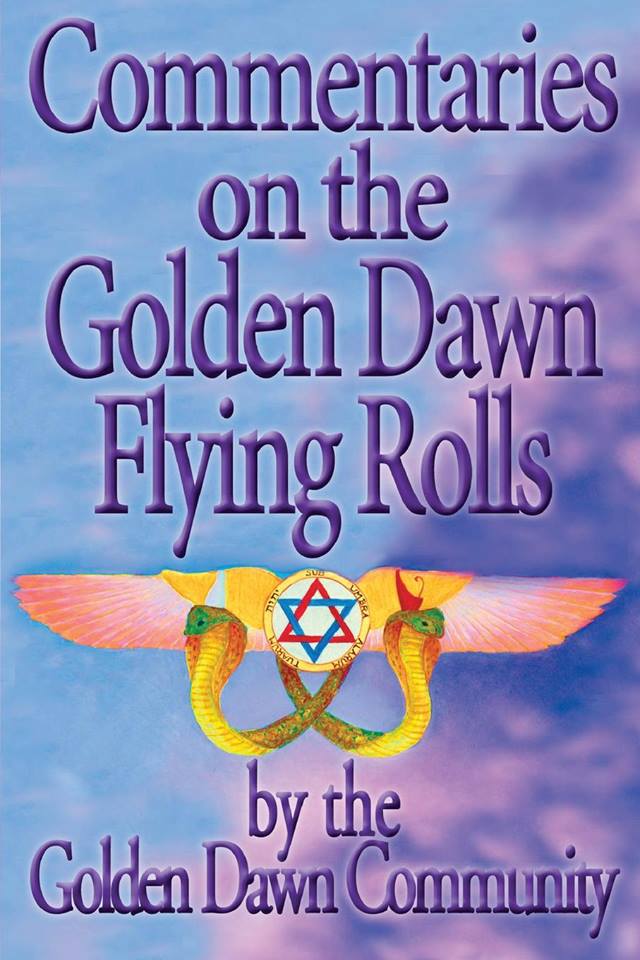
Cover for Commentaries on the Golden Dawn Flying Rolls by the GD Community.
I can't wait to talk about this book. Yes, I know something about this project which has been in the pipeline for a little over a year. For those who do not think that GD members can keep a secret...well, this was a closely guarded secret. Would like to say more, but I am going to be a good lad and wait until Kerubim Press (KP on Facebook) makes their official announcement about this book. (They did the reveal of the cover today, so I think that this blog post is ok.) And yes, I am so going to write a book review on this one; conflict of interest be hanged.

Saturday, March 2, 2013

Book review: Submerged (Cheryl Kaye Tardif)

As most of my regular readers know, I am a writer. What they might not know is that writers have a tendency to dissect books that they read; it is part of our search as professional readers (because you have to be a reader to be a writer) to find the perfect formula for writing the perfect book.  Not so thay we can copy that book, but so that we can write the perfect book that lays within ourselves.

Towards this quest to find the perfect book within ourselves, we tend to collect books that we consider examples of a perfect book written by someone else. Tonight, I am adding another book to my small collection of perfect books.

Submerged (by Cheryl Kaye Tardif) is an good example of a perfect book. The cover is perfect for the story that it advertises. The pacing is perfect with just the right amount of new information being given, and new questions being placed in play. The chapters are the right size--just big enough to satisfy, yet short enough that one is tempted to read just one more chapter...and then another. The symbolism used supports both the plot and the characters. Submerged is a good example of a perfect book.

(I wish that I was as good of a writer as Cheryl is.)

My only concern with it is that some of the culture references might age quickly, and I am not sure if that can be helped given the speed that our culture changes at.

Submerged is a hard book to put into a category. It is about half romance, half suspense, and a quarter supernatural (yes, math is not my friend); it also a tale of addiction, fall, and redemption. I quite enjoyed reading it.

If you didn't already guess, I am giving this book five stars and two big thumbs up. This book is going to be enjoyed by both regular readers and those picky writers.

Submerged is available on Amazon.

[Disclosure notice: This review is based on a pdf that the author provided me. As for the Amazon link, it is just a regular link because I live in Colorado, therefore I can't be an Amazon Associate.]

Thursday, August 23, 2012

Astrology for Yourself (Book Review)

One of the problems that I have with the Golden Dawn material is its general lack of good instructions on astrology. Now mind you, I understand that there are a ton of books out there on astrology; this is as true today as it was in the Stella Matutina days. But for an organization that is supposed to teach occultism and magic, you would think that there would be more.

(This is speaking from the viewpoint of classical [pre-1940s] Golden Dawn and Stella Matutina; it has no bearing on what the modern GD groups are doing. And please note that when you start talking about the "initiated" form of RR et AC astrology--you can fit all the published information on a dozen pages.)

So I am always looking out for possible astrology course books. And a couple of weeks ago, I encountered a new one--well, new to me, that is.

Astrology for Yourself: A Workbook for Personal Transformation--How to Understand and Interpret Your Own Birth Chart. Douglas Bloch and Demetra George.

This is a book that I brought for just a couple of pages. Most of the book's information can be found in other basic astrology courses. But I like the journal aspect of it. And let's be honest--some of the ideas, such as the Moon Phase Wheel, just beg to be expanded and used with other aspects of astrology. (The Moon Phase Wheel could used in one of the Adept Minor subgrades if you are doing a subgrade style course.)

I highly recommend Astrology for Yourself to anyone who is still searching for a supplimental text for their astrology studies.

[Full disclosure: This review is based on a copy that I personally brought.]

Tuesday, July 24, 2012

Book Review Mathers Last Secret

Mathers' Last Secret.
A few years ago, I met someone who tried to impress me with the documents that they had access to. One of the documents was a version of the Neophyte ritual. In order to protect their interests, the copy they showed me had large white blank spaces where some particularly sensitive information was. The person was disappointed because I expressed no interest in what they were concealing.

What they did not realize was that I knew what was in the blanked out sections. It turns out that they were trying to impress me with information that I already had seen through a membership in a previous group.

I wonder how this person reacted to the publication of Mathers' Last Secret, for the Neophyte ritual that they were trying to impress me with was a variation of the AO version (probably through the lineage of BOTA). Given the fact that a person like me had been exposed to the AO rituals before the publication of this book, I wonder how many groups were actually affected by this publication and how many people in them finally breathed a sigh of relief because they could now openly talk about the differences that exist in their rituals compared to the standard Regardie version.

(By "standard," I mean the set of rituals that everyone had access to already.)

Re-reading this book recently, I was stuck by the following statement made by Nick Farrell in the introduction.

The purpose of this book is not to bury the Alpha et Omega, but rather to encourage its development. There is material here which needs to evolve. By looking at it, meditating on it, and TRYING IT OUT the right people can make their own contacts and bring the Order to life in a meaningful way. It might draw some readers into those groups who are already using their own interpretations of the A.O. material. This is all for the good. Equally, it could be the inspiration for other groups to start using Mathers' Last Secrets.

Rather than using the system used in the Bristol Temple of the Stella Matutina, as set out in Regardie's Golden Dawn, the A.O. gives new groups a "new" flavour and approach. The aim of this book is to provide a basis for such a group to take its place alongside the Regardie-style Golden Dawn groups and those, such as the Magical Order of the Aurora Aurea, which are inspired by Whare Ra [pages 21-22 hardcover edition].

(Note that this section may have jumped out at me just because of the debate over Farrell's purpose for publishing this book, and its companion book, King Over the Water.)

Interestingly, the group that is most famous for using one of the AO versions of the rituals (outside of BOTA whose rituals were modified by Paul Foster Case) ended up changing their rituals, so that they do not match this (or any other possible) publication. It makes for an interesting situation where the group that claims to have the best connection to the original AO is no longer even using an AO version of the Golden Dawn rituals. Anyone who actually wants to experience this version of the AO rituals is actually going to have to join a group without no connection to the original AO. (That is assuming that one believes that BOTA and its lineage is not actually an AO lineage.) While Farrell does not state what the "right people" are like, it is safe to assume that he does not endorse the trademark holder of the AO brand-name (if only because of the fact that they really do NOT get along).

(In all honesty, I would not be able to endorse the AO trademark holder either, and it is mainly because I have been called out repeatedly for having opinions that do not support their official Order line--hint: "diversity" and "independence" means that multiple opinions and methods can exist, not that they confirm to an unpublished set of rules made up by an invisible Order and their appointed leader.)

One of the big conversations about this book, and the Neophyte ritual that Mathers created for his Golden Dawn offshoot, has been about the shortcuts that Mathers says are permissible "[if] time be of some importance." Most of the Opening becomes optional, large parts of the lecture for the Grade, and even the "Admission ceremony" is optional. Basically, the only thing you cannot skip is the Oath of Obligation.

In other words, instead of not admitting an Neophyte until a full initiation ritual with a full Opening can be performed, a person could become a Neophtye by just paying their dues and committing to keep the AO secret and remaining loyal to Mathers. This reminds me of some of the fringe Freemasonry rituals that I have seen, where a person takes an oath and gets another honorary title to add to their collection.

And note that I consider this wrong, and I am the guy that argues that the system can be worked with just four people with no lineage at all (aka the Three Officer Version of the Neophyte ritual).

(By the way, in my universe, this is proof that none of the American membership had to travel overseas to recieve Temple initiations--in other words, the American lodges could have been started by people without no initiationary lineage to the AO. Note that this fact does not prove one way or another if the American AO started out as a correspondence school; it merely shows that it was possible for this to happen. It also might indicate that Westcott and Mathers did not think that undergoing the initiation rituals was necessary for advancement in the Order, and why they never undergone the initiation rituals of Golden Dawn themselves...I am still waiting to see proof that they did undergo the GD rituals.)

Does a regular member of the modern Golden Dawn need to buy this book? Probably not...unless they want to study what Mathers did after the Golden Dawn suffered the great Revolt of the Adepts. If you want to study and perhaps even experience these rituals, then this book is neccessary. For people not into collecting all the versions of the Golden Dawn rituals, you probably want to give this one a pass (it is just a set of rituals by Mathers and some comments by Farrell).

Mathers' Last Secret is available for purchase on Amazon.

[This book review was based on the hardcover edition, a copy which I paid full-price for on Amazon.]

Friday, April 20, 2012

Developments in Golden Dawn color scale work


Golden Dawn Colors of the Sub-Sephiroth of Netzach of Briah.
One of the nice things that I can say about the internet, and the little corner of it that Golden Dawn inhabits, is that it is nice to occasionally see the work that other people have done in the Golden Dawn tradition. For me, it is especially interesting to see the results that other people got in those areas that I had already done experimental work in.

For instance, back in the first quarter of 2004 (it was sometime between December 2003 and March 2004---I don't really keep good dates in some of my GD sketchbooks), I was working with the Golden Dawn color scales. On the side, I was doing some specialized spell work. How specialized? Well, I needed the colors of several sub-sephiroth for targeting purposes.

The concept for extending the color scales is easy enourgh to figure out, which is probably why it is not considered important or secret enourgh for some Adepts. Personally, I like using the color scales and their extensions. At heart, I am still an artist despite the fact that I chose to be a slimy literary historian and writer of bad Russian Bride adcopy instead.

(I have absolutely no idea where the extensions of the color scales would fall in the curriclum of Golden Dawn, other than it is someplace in the Inner Order...or at least, the style of Inner Order that I am used to.)

A couple of days ago, I got to see a slideshow about the Cross of Victory. And today, I got to leaf through Volume V, Edition 3 (Vernal Equinox 2012) of the Hermetic Virtues journal which has an article by Tabitha Cicero in it.

(Is it actually "leaf" when it is a pdf? Yes, that is a writer's question.)

Tabitha's article, The Path of the Chameleon: Golden Dawn Color Studies, focuses on the logical extension of the Golden Dawn color scales. Basically, the color scales can be extended to provide colors for all the possible energetic interactions. For instance, the color scale work that I was doing in early 2004 can produce a palette of four hundred sub-sephiroth colors to allow one to tap into very specific sephirah energies.

(Actually, there is no need to stop at four hundred colors; one can go for a sub-sub sephirah if one desires to. And sub-sets can interact with other sub-sets; there are millions of colors to generate if one is willing to spend lots of time on this particular Golden Dawn method.)

Anyways, it is interesting to see that other people have also followed the various hints and instructions of the Adept Minor material and extended the color vocabulary of Golden Dawn to include energies like the sub-sephiroth. If you get a chance, be sure to buy a copy of Vernal Equinox 2012 Hermetic Virtues journal and look at all the pretty colors of the various sub-sets that Tabitha is exploring.

(I will admit that my color scales are slightly off compared to the ones that I have seen produced by Olen Rush, Nick Farrell, and Tabitha Cicero. There is a reason why I decided to make a living as a writer rather than as an artist. Nevertheless, in some cases, I am actually in the general ballpark of the colors that they have produced. It may be just simply the fact that I have very little formal art education---outside of a couple of classes, I am a self-taught artist. Or it could be the fact that I prefer working with colored pencils. Nevertheless, take my color examples with a grain of salt and work out your own set.)