Showing posts with label Westcott. Show all posts

Wednesday, September 18, 2013

International Talk Like A Pirate Day

Pirate Kitty would like some rum cooked shrimp for his dinner.
Hi everyone! Today be September 19, and that means that it be International Talk Like A Pirate Day.

And let's be honest, everyone in Golden Dawn be a pirate. It be a long and noble tradition we have.

Don't believe me? Well, consider this.

Sometime before 1888, a mesterious man wrote down t' treaayes o' a secret lodge tradition in a document that we now call t' Cipher Manuscript. This was probably Kenneth MacKenzie. Some claim that this system was stolen from a previous system o' lodge initiation. Maybe even from Freemasons or t' evil SRIA. Therefore, MacKenzie be a pirate.

MacKenzie went t' Davy Jones' locker. Leavin' his widow with a pile o' papers that she did not want. Enter William Westcott, a man o' knowledge, and a conjuror of dead men ghosts.

Westcott convinces MacKenzie's bonnie lass that she should give him t' papers, because he belongs t' t' SRIA. T' Cipher Manuscript was not t' booty o' t' SRIA (accordin' t' some). Sad Widow gives up t' papers t' Westcott, a crime o' petty copyrites infrin'ement. Therefore, Westcott be a bigger pirate than MacKenzie.

Westcott then ropes a nice young man by t' name o' Samuel Mathers t' help recruit members t' work this awesome system o' spiritual advancement. Westcott also creates a set o' letters from a person who does not exist to shore up his claim t' t' treaaye. Mathers knows that t' letters be fake. Therefore, Mathers be a pirate.

Later, Mathers fights Westcott. T' prize? Complete control o' t' good Order o' t' Ancient Golden Dawn. Mathers does this by twirlin' a cutlas around while shoutin' that Westcott be a liar. Mathers sails t' France, gets involved in politics and bebuckos t' sinister Aleister Crowley. Mathers be even bigger pirate than Westcott.

Mathers t' keep his crew obeyin' his orders, then created a set o' invisible buckos who told him how wonderful he was, and how his students were t' pay him their last bit of gold. Mathers not only be big pirate, but a delusional creator o' tall tales and creepy ghost stories too.

Crowley a kind young man who fancied everythin' that moved includin' both your grandmother and grandfather, thought that this was bad behavior on t' part o' Mathers. So Crowley fought Mathers. T' prize? T' hearts and minds o' young men and beauties everywhere. And maybe their sex too. And their goats. Crowley shot at Mathers usin' a self-published set o' books, a new system o' attainment, and a boatful o' lawyers. Crowley also had invisible buckos, who told him that he was t' Messiah and t' best thin' since white bread. Crowley liked t' feed his followers t' demons and sharks. He also like t' be in t' newspapers very much. He reveled in his wickedness by writin' prose and poetry for young scallywags. Crowley be even bigger pirate than Mathers, and more drunk than a skunk to boot, but was very sexy.

In t' meantime, several other people started t' run businesses based on t' rituals and lessons o' t' Golden Dawn. Some o' them were con-beauties, and some were scurvy dogs. They all claimed t' gold o' t' seekers o' t' Golden Dawn. They were all pirates.

Then along came a nice Jewish lad by t' name o' Israel Regardie. He saw all t' pirates as dubious crew who should be made t' walk t' plank. He stole their rituals and lectures, hence robbin' them o' their hard-earned gold. He published as did t' wicked Crowley. This made many people upset with him. They claimed that he was a bigger pirate than they were.

Many students and seekers found t' writin's o' Crowley and Mathers and searched for t' treaaye o' Golden Dawn. Some o' them had lawyers and tame sharks and claimed t' be t' sole heirs o' Westcott, Mathers and Crowley. Others just dug a lot o' holes. Obviously, all o' these men and beauties were pirates also.

T' recap, six men sat on a dead man's chest and refused to share the loot. Six pirates, seven--counting you!

Pass the rum, and give another shrimp to the cat.

Happy International Talk Like A Pirate Day!

Tuesday, April 24, 2012

Ultimate extreme of secrecy

Here is a comment that I made on another blog that I want to expand on:

By the extreme rule of secrecy, everything is oath-bound and nothing can ever be said (or written) unless the person you are talking to was involved in an intiation or ritual that you were physically present at.

In other words, anything that was ever secret is still considered oathbound. And nothing can ever be removed from the oathbound category once it was declared oathbound.

By the way, this means that not only were Israel Regardie and Aleister Crowley oathbreakers, but so was William Wynn Westcott and Samuel Liddell (MacGregor) Mathers...because they all wrote about things that at one time was covered under the secrecy oaths of a previous esoteric tradition or society.

This is the ultimate extreme of secrecy. It is the extreme rule that says that if you are involved in the esoteric, you never, ever talk about it in public. The only time you talk about the esoteric and oathbound material is behind closed doors with a guard outside.

This is a level of secrecy that no esoteric writer (or blogger) can actually uphold. You cannot even advertise your own esoteric society if you are obeying this extreme understanding of secrecy.

Therefore, I honestly do not know anyone who goes this extreme route...except for those who would like no one else to talk about the esoteric. These are typically students who think that they understand the real purpose of secrecy, and have missed the boat. I think that we have all dealt with these people at one time or another.

By the way, one of the weird things about this level of secrecy is that stuff that the esoteric traditions adapt and take into their system also becomes oathbound. For the instance, the Hebrew alphabet, invented for things like accounting, once taken into an esoteric system (Kabbalah) is now considered oathbound and secret. Therefore even the proper order of the Hebrew Alphabet cannot be discussed if you are an initiate of an extreme secrecy tradition without a guard at the door.

Basic math, the ability to start a fire, most mythology, color theory---all these subjects you have to quit talking about if you are a member of the extreme secrecy camp.

If you find this extreme level of secrecy silly, you are not alone. But just remember there are those students out there, who despite discovering the first hints of the esoteric traditions from books, who believe that this is the level of secrecy that the esoteric traditions have to adhere to.

Saturday, April 21, 2012

Vault as an example of extended GD color scales


Vault of the Adept color study Venus Wall 2000 MDE.
Some of my readers may be curious about how I realized that the Golden Dawn color scales could be extended in the fashion that I mentioned in last night's post. The answer is pure experience.

In 2000, during the opening days of Bast Temple/BIORC (as we were busy reinventing ourselves from the previous group, the EOEW), I had cause to turn my eyes back to my Golden Dawn studies after taking several years off to deal with the EOEW. One of the studies that I did involved the Vault of the Adepts (the ritual chamber that is necessary for Second Order operations).

At the time, I was restricted to the published Regardie material and the oh-so few notes that I have taken during my time in the IIOGD. So it was from Westcott's lectures about the Vault that I discovered the thread about the idea of mixing color in various sub-sets; the Vault itself can be classified as a specialized sub-set.

Oh, I had also gotten a crash course in the basics of color theory---it happened over a pizza.

After completing my first color study of the Vault, on index cards (the above picture is from that particular round of study), a little voice in the back of my head asked, "Why stop there? Why not continue to extend the use of the color scales further?" So in 2004, when I found myself needing a very exact set of targeting foci, I simply resumed that line of work to create a more specialized sub-set of colors for my own magical purposes.

(I have done several studies of the Vault coloring since the first one---I am about to start a new one as soon as the current college semester is over.)

Of course, one can argue that what I did was merely put together something from a dead bunch of papers. I like to think otherwise, for I belong to that division of the esoteric traditions that believes that published material allows the great Adepts of previous ages to instruct the students of the current age. In my mind, Westcott (thanks to Regardie) spoke to me across the ages and pointed me in the right direction.

Now, all this work I did took place before I saw a complete version of the Book of the Tomb. I was also ignorant of the Westcott Enochian Tablets. Both of which I have looked at with some interest, for I am always curious to see how different my work is from other students of the tradition. Doing this work before learning of such things just proves to me that there is a natural progression to the work that we do in Golden Dawn. This belief is based on pure experience.

Saturday, March 10, 2012

Concord and Peace of the Three

S.R. just posted an appeal for peace in the Golden Dawn community. Having experienced the Denver Witch War of the 80s and having been an "active bystander" in the flaming Golden Dawn feud of the last decade (only half of its length), I doubt peace will actually occur. I honestly do not see any chance for peace in the Golden Dawn community until one of the camps steps completely away from the Golden Dawn label, especially considering how wide the gap is between the perception of the two parties of what Golden Dawn is about.

As proof that such a peace is possible, S.R. notes that he was taught that Samuel Liddell MacGregor Mathers (Head of the Rosicrucian Order of the Alpha et Omega), Dr. Robert William Felkin (Head of the Stella Matutina), and Arthur Edward Waite (Head of the Holy Order of the Golden Dawn) met and agreed to mutually recognize each other's Orders.

This is only partially true. A "working truce" occurred, but there is no evidence that it ever was a formal meeting and recognition between the three. And it fall apart quickly.

Initially, there was a concord between the Stella Matutina and the Independent and Rectified Rite (Waite). This concord broke because Waite discovered that Felkin was communicating with J.W. Brodie-Innes, Mathers, and Westcott. Waite could not tolerate peace with Mathers or any of his supporters.

And officially, there is a lack of peace between the three Orders.

When the Fellowship of the Rosy Cross formed in 1915, after the Independent Rite suffered a series of schisms, its constitution said "The Independent and Rectified Rite, with its dependencies, if any, in so far as now in activity, and the Stella Matutina Temple, together with its dependencies, are not in communion with the Fellowship of the Rosy Cross, and cannot be Visited or Joined."

Likewise, the 1916 New Constitution of the Stella Matutina says, "Members of any other Temples applying for admission, must be clearly warned that they will be required to give a definite pledge not to work in future with or under D.D.C.F. [Deo Duce Comite Ferro--Mathers], S.R. [Sacramentum Regis---Waite], Sub Spe, or Dr B. [Brodie-Innes]." Furthermore, in the section about the conditions where expulsion of memebrs is talked about, besides mentioning that six members were expelled when the Order broke with D.D.C.F., it says, "I have had to ask one Member to resign, because she told me she intended to join S.R.'s new Society."

And people outside the Concord of the Three did not foresee lasting peace between them. For instance, Westcott presumed that after his death that the Three, along with "Crowley and Co." would "make claims on my G.D. properties and may each make public claims derogatory to my historical interests in the G.D. and Isis [Urania] Temple."

Based on all this, if there was ever a meeting between Mathers, Felkin and Waite, the resulting peace did not last very long (and I really doubt that the meeting actually happened). And can you really picture Mathers agreeing that anyone else was legit?!

As for a possible peace between the two current Golden Dawn camps, I will not hold my breath; for the one side will only allow peace when the other side acknowledges their absolute right to rule the entire tradition, and the other side refuses to allow themselves to be repeatedly trashed as being less than fully Golden Dawn. That is how I see it. If you disagree, you know where to comment.

Friday, February 24, 2012

Book Review King Over the Water

Would you like an antacid with your Mathers' Last Secret book?
When Mathers' Last Secret came out, one of my friends joked that we should market a brand of Golden Dawn antacids. I regret not following up on that suggestion, for the latest book by Nick Farrell, King Over the Water: Samuel Mathers and the Golden Dawn, is going to just increase the market for antiacids among some members of the Golden Dawn community.

This book review is not for the antiacid crowd. My suggestion for the antiacid crowd is just continue on with your work and ignore this book. This includes anyone who thinks that Mathers was the genius behind Golden Dawn, that Mathers was in contact with some uber-Adept, or that secret documents should remain unpublished and Secret Chiefs and their contacts unquestioned. And if you choose to ignore my advice, and buy the book anyways, just remember that I am willing to sell you a big jar of premium Golden Dawn brand antiacid.

In fact, if you feel that Mathers was perfect and/or the Secret Chiefs are perfect, you may want to ignore the rest of this book review as well and just go pop an antacid right now.

King Over the Water
*antacid time*

I like this book. It is long overdue. It will be a valuable addition to anyone's Golden Dawn history or document library.

Have you taken your antacid yet?

(One would hope that the antacid crowd have taken my advice and wandered off already, but I know that they would rather stick around and throw rotten eggs at me for liking this book. *sigh*)

The biggest problem with this book quite honestly is that those people who need to read it the most will ignore it because their superiors will tell them that it is just a pack of lies and a political ax job meant to destory Mathers and their superiors' reputations. And they will believe their superiors. Farrell tries to address this issue by pointing out some of the things that dishonest Orders have done in the past. I would love to say that the offenses he lists are isolated events, but they remind me of the laundry list of crap that I have seen in the various esoteric groups that I have been involved in.

My advice to one and all is: Be wary of anyone who holds an office in an esoteric Order, especially anyone who holds power because of the documents and contacts that they alone control. And be prepared to pop a lot of antacids. Why? Because a lot of people look fondly back on Mathers and decide to act just like he did. This tends to lead to the exact same results that the early GD experienced---do I need to remind you of the last time that this happened?!

Samuel Liddell (MacGregor) Mathers, while necessary for the birth of the Golden Dawn system, is not the person you want to model your behavior on as an officer or Chief of an esoteric Order.

One of the things that I think that every student of Golden Dawn should study is the history of the early years of the Order. It is part of our heritage as members of the Golden Dawn. I don't care what branch of the Golden Dawn tradition you belong to, the early history is important to know.

Unfortunately, up until this book, no history of the early years of the Order has been written by someone who has stood on the inside of a functioning Golden Dawn lodge. The closest we have gotten, previous to this book, are a few Freemasons who chosen to write about esoteric Order history. Because of that there are some things that are perfectly "normal" inside the GD envirnoment that end up sounding mighty strange to an outsider, and the histories so far have made the early GD sound slightly wacky.

Does Farrell make Mathers sound like a complete loon? No. Farrell makes it clear that Mathers had some personal issues, but they are no stranger than those of most of the people that I have sat in lodge with. It was rather interesting to see Farrell point out the possible psychological issues that may have been driving Mathers actions.

Over the years, I have tried to get people to explain to me why Mathers did certain things (ex. the Horos encounter---why would anyone in contact with Secret Chiefs fall for Horos and believe that they were the real thing). And this is one of the best attempts that I have seen of trying to figure out what was really going on and why Mathers occasionally made a decision that just makes your head hurt as you try to figure out his logic. Is Farrell's solution the only one? No, but it will do until something better comes along.

(If the antiacid crowd is still present, I would like to point out that they are free to hunt down records and documents, and write their own history of Mathers and the early days of the Golden Dawn.)

In all fairness, this book is mistitled---it deals a little bit with every significant member of the Golden Dawn during its early days. Westcott, Crowley, Moina Mathers, etc. But the main focus is MacGregor.

One of the accusations that will be leveled at this book will be that Farrell is not qualified as a historian. I am going to have to disagree with this notion. Having spent a lot of time learning the profession, I can see the hallmarks of a historian in this book. I might not be able to track down all his sources, but I can see that he was actually working from actual sources (primary documents).

As a history of the early days of Golden Dawn, and a biography of Mathers, this book is a welcome addition. It is not the ax job that I expected it to be, occasionally one even feels sympathy for Mathers.

In addition to the history of early GD and biography of Samuel Mathers, King Over the Water also contains several early A&O (GD) documents---an early version of the Book of the Tomb, the Z documents (which I learned is actually a single document divided into three parts), and an earlier version of the Sword Consecration ritual. (Or at least, these were in the earlier draft of the book that I read.)

Each one of these documents is of a particular interest to me. The version of the Book of the Tomb that the BIORC uses is much later, and has some additions made to it (that what happens when an Order believes that its own members can contribute to the system without having to rely on Secret Chiefs); therefore, it is nice to see an earlier version of it (beyond the photocopies that I have been given by others---this is the earliest version I have seen of the Book of the Tomb). The Z Document, just like the material in Mathers' Last Secret, has some material in it that makes me wonder if my Mother lodge reinvented the wheel or actually concealed a major part of their actual lineage (at this point, I really wonder if my lineage does not go back to Mathers on the one side through BOTA---of course, that cannot actually be true).

One thing that the reader should know is that Mathers' Last Secret and King Over the Water are very much tied into one another. If I was to assign them as part of the required reading for a lesson unit, the two books would be assigned together---for parts of each book is only understandable if you have ready access to the other. Then again, that is just like the rest of the Golden Dawn system, isn't it? For instance, the argument that Mathers did not understand the Z Document is dependent on looking both at the shortcuts that Mathers approved of for A&O rituals and the Z Document as Mathers knew it.

Of course, beyond the fact that Farrell's history reveals that Mathers and company was composed of human beings, the publishing of these documents is going to annoy some people. It is natural to be annoyed when your branch of the tradition insists on absolute secrecy.

But the biggest annoyance is going to be the fact that Farrell actually presents a strong case that Mathers' Secret Chiefs were actually ASTRAL. Or some other non-physical entity type (I am including stuff that comes out of one's brain as "non-physical" here). And that more than one person in the early GD had such contacts. The reason that this is going to annoy a lot of people (and there is more than one Order involved here) is that there are several Order Chiefs out there who claim to be in contact with the "one and only" set of Secret Chiefs.

So there you have it, the three strikes against this book (and the reason I should be making a fortune selling Golden Dawn brand antacids)---Mathers and company are human; there are early GD/A&O documents included in this book; and the Secret Chiefs are either astral or a product of the human mind. Nevertheless, this is still the best explanation about why events unfolded the way that they did.

Nick Farrell's book, King Over the Water--Samuel Mathers and the Golden Dawn, is available to order on Amazon.

[Full Disclosure Statement and shameless self-promotion: This book review was based on a pre-publication version of the book given to me by the author. If you would like me to consider reviewing your book, feel free to email me a electronic copy through my lodge email address: basttemple at msn dot com. Remember that my reviews tend to involve the selling of antiacids.]

Friday, January 20, 2012

Working Draft or Finished Project

One of the leaps of faith that occasionally disturbs me is the level of confidence that people place on the Cipher Manuscript. And this includes the amount of faith that Westcott and Mathers placed on the document. It is assumed by people that the Cipher Manuscript is a finished project.

Thanks to my experience in designing rituals, I am not confident that the Cipher Manuscript actually represents a finished project. To me, it looks more like an ongoing work in progress where the creator changed their mind about earlier parts, made changes and did not go back to correct earlier pages because correcting pages written in a cipher is a pain in the lower regions.

(For the record, I sometimes do not correct my own outlines, written in the clear, when I change my mind later in the process of ritual design. There is a possibility that the creator of the Cipher Manuscript didn't either. And he would have had more reason not to.)

Yes, I realize that I am a Golden Dawn heretic. The myth of an earlier Order implies that the Cipher Manuscript has to be the shorthand memory aid for a pre-existing set of rituals. This is the way that Mathers and Westcott and most Order leaders have treated it. But what if it is actually a rough draft and not the final draft?

Personally, some of the difficulties presented in the Cipher Manuscript, including the change in the number and style of pentagrams used in the rituals, can be best explained if the Cipher Manuscript is actually an rough outline with the writer changing their mind as they go along and not bothering to make corrections in the earlier sections. Yes, it is heresy...but it is something you have to consider if you are serious about studying the Cipher Manuscript.

And now, we will invoke the spirits of the blogosphere to provide evidence that the Cipher Manuscript is actually a finished project. (No fair just screaming that Third Order says it is a finished project, you must show your work and evidence---otherwise I am going to continue to use to use my outlines and ritual performances as proof that it is a rough draft---and using the rituals that Mathers and Westcott built from the outline is not actual proof either.) Oh great spirits of the blogosphere prove to me that my lack of faith in the Cipher Manuscript is misguided and just plain silly---I dare you. (Hey, it has been a slow Golden Dawn news week...because I chose to ignore certain postings on another blog...and you can't blame a boy for trying to create a new excitement around here. Unless you really want me to discuss the posts on that another blog...in which case, feel free to say so in the comment section.)

Monday, January 9, 2012

More history and the color scales

King Over the Water pontential cover.
Talking to a Soror from my lodge about the post about Impressionism and the Golden Dawn color scales, I realized that I need to do a follow-up to it with some additional information. She asked some questions---some involved me looking up information to confirm things I already suspected---and I realized that if she had those questions that other people might be curious about the answers too.

(For the record, it was the potential cover of Nick Farrell's book that made my mind connect several facts together and realize that the expanded color scales of Golden Dawn could only result after 1840. And as far as I know, I am the first one to realize this fact...or at least, the first person to actually consider it to be important; I don't remember anyone ever writing about this topic before.)

First, just to get it out of the way, I do not believe that Moina Mathers was a "modern woman" or a "feminist." I am not looking for an example of a modern woman or a feminist---I am looking for an artist. The reason that I am looking for an artist is that the Golden Dawn color scales have too large of a color vocabulary to be the sole invention of a non-artist.

Agrippa's color scales are an example of a set of color scales created by a non-artist; the color vocabulary is simple and basic. The Golden Dawn color scales, on the other hand, has a wide color vocabulary. Now, one quarter of it is just layering an occult idea (colors attract energies) onto the standard artist's color wheel---something that is easily produced by non-artists. But the other three quarters involve a series of colors so rich and varied that one needs a cheat sheet with paint samples on it to accurately reproduce it (or a digitual camera and a really good color printer).

I have seen no evidence that Samuel Mathers or Wynn Westcott had such a large color vocabulary. The concept that color attracted magical forces was not a new idea---Agrippa and the SRIA are solid proof that the idea was common currency among occultists. Nor have I seen any evidence that convinces me that the SRIA is actually the source for the expanded color scales. Occasionally, someone points to the SRIA as the source of the Golden Dawn Vault of the Adepts---but no one has yet to provide what I would consider proof of this fact. When Westcott mentions that there was an older color scheme for the Vault, he may have been referring to the color lore of the SRIA in his day and age.

Therefore, the idea that color attracts magical forces is common currency of occult thought of the 1890s, but the expanded range of color vocabulary is something new and is the product of an artist---therefore who is the artist? Westcott? Samuel Mathers? Moina Mathers? Someone else? Until someone proves otherwise, I am presuming that Moina Mathers was the one to expand the color vocabulary, and therefore it is she (and not Samuel or Westcott) that is truly the source of the Golden Dawn color scales.

As I said, maybe Nick's upcoming book, or maybe Tabatha's, will convince me otherwise.

Possible cover for Concourse of the Watchtowers.
The other thing that my dear Soror brought up was the possibility that it is not water colors or oil paints that are being used in the color scale work. That maybe it is color pencils that were meant to be used. I told her that I was positive that we were supposed to be doing the color scale work in "wet medium." There are some effects that can only be achieved with the use of wet medium---not even the use of modern paint programs can duplicate some of the effects. (Then again, I like the physical process of using a brush to create art.) Furthermore, I told her that color pencils are a modern art development, and that I was positive that the expanded color scales (usable by all Adepts and not just those who were professional artists) had to be an invention occurring after 1840.

Looking it up, I learned that the history of art materials backs up my conclusion. Colored pencils were not marketed to artists until after 1900. It is not until 1920s that we start to get a wide range of art-grade color pencils. Prismacolor pencils are not introduced until 1938. Likewise for other dry mediums---wax crayons 1903; oil pastels 1925; paint sticks 1966.

The only two exceptions for dry medium would be colored chalk and pastels (pastels are pure pigment with a binding agent)---chalks have been used for thousands of years and pastels for about three hundred years. Yet the amount of time that they have been used removes them from the running; if they were suitable for expanding the color scales, the color scales would have expanded much sooner and I would not be looking for an artist inside Golden Dawn to credit the expansion with. Besdies, these two mediums are not actually conductive to making talismans and lamens---which is one of the primary reasons for the Adept's studies of the color scale system.

A final thing I must mention is the fact that we do have a lot of evidence that the color scale work of the Golden Dawn Adept was a new development. The sheer amount of variation between the color scales of various Golden Dawn offshoots, and even between lodges of the same Orders, indicate that the system was not developed enourgh to have standardization. An older, more developed system would have figured out a way to decrease the number of variations.

The expanded color scales are not something that you can look back to a previous esoteric group and find purer information about...unless you want to toss it out completely and go back to the simple color scale used by Agrippa and earlier occultists. In fact, the expanded color scales are so new that the period of its best development may still be in the future.

Sunday, January 8, 2012

Impressionism and the GD color scales

King Over the Water by Nick Farrell.
The Book of the Concourse of the Watchtowers by Sandra Tabatha Cicero.
The other day, I was reminded that there are some soon-to-be-released books that are on my shopping list (well, after I managed to crawl out of the monetary hole that I have fallen into). Both Nick Farrell and Sandra Tabatha Cicero posted possible covers for their respective books (I say "possible" because I know how things change at the last moment in publishing).

Looking at the covers, I realized something---our required color scale work in Adept Minor (5=6) was not possible previous to 1841. Or at least, not in the form and style that we do it today.

Don't believe me? Think about how you did your color scale studies. Were there tubes of paint involved? If there were tubes of paint involved, then you are using a post 1841 method. Or did you use watercolors of straight from the pans of a box? In which case, your method of study could not have developed before 1832. The idea of using watercolors from a box only dates to 1766; before that point, watercolors were sold in lumps that had to be hand-grated before using.

The ability to do color studies while sitting in your living room is a product of the Victorian Age. Before the improvements to watercolor paints by Henry Newton and William Winsor in 1832, only professional artists worked with paints. Amateurs did not start to paint until Newton & Winsor developed the methods of creating watercolor paints that could be used directly from the box. Queen Victoria helped lead a national passion for amateur painting.

Paint tubes were invented by an America, John Goffe Rand, in 1841. Rand's invention was a technological leap for the artworld. Rand would tell his son that without his invention that "There would have been no Cezanne, no Monet, no Sisley or Pissaro; nothing of what the journalists were later to call Impressionism." I would go one step further and say that there would be no required color scale work in Adept Minor if he hadn't invented the paint tube.

Please remember that I am not saying that color was not important in magic previous to the Victorian Age (Agrippa is enourgh proof of the importance of color in magical work among our magical ancestors). What I am saying is that the creation of color scales studies and flashing tablets were much harder before that point, and were unlikely to have been an important part of the esoteric lesson plan---at least among amateur artists.

Westcott mentions that there is an older color scale that were used in the ancient Vault of the Adepts. Exactly what this older color scale looked like is hard to say for sure; the Adept Major ritual doesn't develop the idea enourgh to get a clear look at it without some knowledge of art history. There are also alchemical formulas that are actually about making pigments. So while there is definitely color scales involved in the older magical systems, they were placed much higher in the estoteric Grade system.

One of the things that Nick and I have disagreed over (publically on the internet if you want to go looking---I can't remember what Golden Dawn forum it was on) is the importance of Moina Mathers in the creation of the modern Vault of the Adepts and the modern color scales. My logic tends to be: if I needed a crash course in color theory to understand the color scales and its development into the Vault, then an artist had to be involved. My best bet is Moina Mathers, who was trained as an artist. Nick says that Samuel (MacGregor) Mathers and Westcott could be the ones that brought it in---I am not sure if he was implying that the color scales were built up by a previous esoteric group prior to their founding of the Golden Dawn or if it was invented by them (Nick will reply in the comment section about that one).

One thing that would be helpful to determine which one of us is right would be knowledge about whether Westcott or Samuel Mathers were amateur artists before meeting Moina. If they only started working with the complicated color scales after meeting Moina, then I am inclined to continue crediting Moina---after all, she is the one that was responsible for painting the first RR et AC Vault of the Adepts. I am hoping that one or both of these upcoming books reveals some evidence that would make the answer to this question clearer. Knowing the source authority would clear up some questions that I have about the color scales...beyond how much credit to give to Moina.

But while I am unsure about the source authority for our color scale work, I am positive that it is definitely an esoteric development of the Victorian Age. Before that date, the color scales were much simplier, and applied in a different manner when it came to magical workings. This fact affects a lot of stuff that we do and study today---a cascade effect---including the Tarot and the making of magical talismans.

And just in case, you are wondering, the modern Victorian Age color scales is something that I am not willing to abandon, no matter how wrong they are according to the older esoteric material. I may not be good at alchemy, but I am a fair hand with a paintbrush. For maximum outrage, just remember I use the modern color scales with the Elder Futhark (the Norse Runes).

Saturday, January 7, 2012

Who was Johannes Trithemuis?

Polygraphiae.
Joannes Trithemius (born Johann Heidenberg, 1 February 1462---13 December 1516) was an abbot. During his time as abbot of Sponheim, he increased the library of that abbey from a poor fifty volumes to a rich thousand plus. During his time at this post, he acquired a reputation as a magician. In 1506, he switched posts, becoming the abbot of the Schottenkloster where he remained to the end of his life.

Among his students were Heinrich Cornelius Agrippa (1486---1535) and Paracelsus (1493---1541). Trithemius was a writer focusing on "steganography" (cryptography). His most famous work, Steganographia, ended up on the Index Librorum Prohibitorium in 1609. On the surface, the book appears to be about black magic, in particular using spirits to communicate across vast distances. But the black magic is merely a cover for the real contents of the work, which deal with cryptography and steganography---or for those of us with pudding in our heads, codes and ciphers.

It is interesting that Trithemius chose to disguise his writings about secret writings inside a cover text about black magic and spirit (angelic/demonic) messengers. It is the cover text that got him into trouble. His teachings included oaths of secrecy and "delibately obscure discussions of the technique" (as one writer put it). Trithemius also encouraged Classical learning and everyday subjects, believing that they were necessary to those who were involved in theological pursuits. It is not hard to imagine Trithemuis getting into trouble over his ideas.

(I will admit that I am puzzled about why he didn't pick a different subject. Then again, there is another possibility...)

Steganographia was not printed until 1606, though the unfinished manuscript was circulated in manuscript form. Of course, from a Golden Dawn viewpoint, Polygraphia (1518) is the more important work.

The important page from Polygraphia.

A page from Steganographia.

Another page from Steganographia.

One can understand why Johannes Trithemuis got into trouble.

Ah, boyhood memories.
Now, as I noted already, the importance of Johannes Trithemuis to Golden Dawn is his book, Polygraphia. Both William Wynn Westcott and Kenneth Mackenzie had copies of this book in their libraries. The question is Why? In the case of Mackenzie is was probably more about the codes and ciphers; his pen-name was Cryptonymus and he occasionally refered to his wife as Sister Cryptonyma. In Westcott's case, I lean more toward his interest in the esoteric, including magic. But in all honesty, the answer for both men must be a little bit of ciphers and codes and a little bit of magic. They would be the first...or last...magicians to have an interest in codes and ciphers (both Dee and Agrippa leap to mind).

Yet the existence of the book in both libraries create a trust problem when it comes to the various stories that Westcott told about the Cipher Manuscript. One of the stories says that Mackenzie had seen the Cipher Manuscript and had "expressed ignorance of it and wonder." Yet Mackenzie would have been able to decipher it easily, even without a key---a key, he just happened to have in his own library. And Mackenzie, like Westcott, was a member of many societies and Orders and a collector of esoteric lore. I am not sure that Mackenzie could have expressed ignorance and wonder over the Cipher Manuscript...but that is a subject for another day.

Friday, January 6, 2012

Basics of ciphers and codes

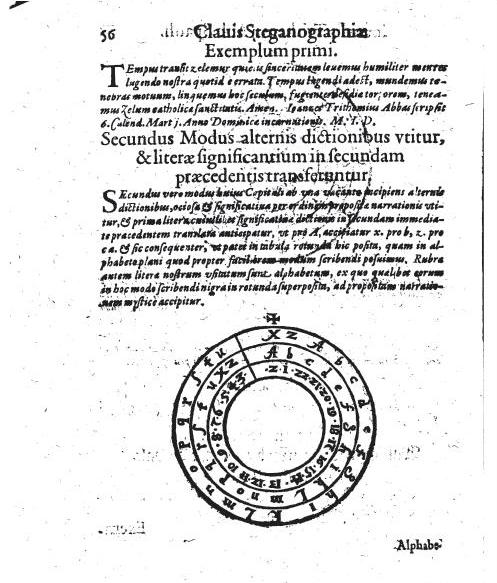
Page from Polygraphia bearing the GD Cipher.
The student at this point of the discussion about the Cipher Manuscript needs to know a few basics about codes and ciphers. In the Bast Temple version of the Zelator (1=10) initiation ritual, the initiate is presented with several examples of codes and ciphers in the additional third part of the ritual.

(The third part of the Bast Temple Zelator ritual is so irregular from the viewpoint of other Golden Dawn Orders. It was inserted into the ritual to allow the ritual introduction of geomancy to occur during the Zelator initiation, rather than forcing the student to wait until Theoricus (2=9) where the traditional Golden Dawn Orders ritually introduce the system to the initiate. To flesh out rest of the third part, several other subjects were also introduced, including codes and ciphers. One of the results of this minor change in the ritual is that Bast Temple students get to study the Neophyte and Zelator sections of the Cipher Manuscript while in Zelator without someone frowning at them about studying material beyond their Grade.)

One of the ciphers presented to the Zelator is "Thee Cipher," the cipher that was used in the foundational (DNA) document of the Golden Dawn---the cipher of the Cipher Manuscript. The cipher dates to before 1518. The source of the cipher for Frater C was probably from Johannes Trithemius' Polygraphia (original edition 1518). The above pictue is the page that the cipher is found on from the 1561 edition.

The text roughly reads in Old French (according to Wikipedia):

Fifth Book.
Another alphabet, by which Honorius, a. k. a. Thebanius occultly describes the rules of magic.
{Theban alphabet cipher}
Another alphabet, by which some alchemists wanted to secretly use & describe rules & secrets of their science; making this science look more estimable than it deserves.
{GD alchemical cipher}
Usually alchemy is accompanied by several servants, familiars and domestics, who...

(Before you ask---no, I do not know how Trithemius finished that sentence.)

Trithemius' Polygraphia was in circulation among the members of fringe masonry in 19th century England (though to what extent is uncertain). Both Kenneth Mackenizie and Wynn Westcott had copies of this book in their libraries. A common assumption is that Frater C was very much into the use of ciphers. This may be true; it is known that Mackenzie (one of the possible creators of the Cipher Manuscript) was rather fond of ciphers. Another common assumption is that because Westcott had a copy of the cipher key, all his stories about how hard it was to "translate" the document are more to impress the listener than actually accurately relay information.

Exactly how hard is it to work with a known cipher?

An message to decipher...if you want to try, that is.
For instance, take this example. It is 58 words and it took me 30 minutes to sketch with a pencil, and another 15 minutes to ink it. So forty-five minutes to encipher a single page.

I am not sure how long it would take someone to decipher it even with the use of the key provided earlier. Frater C modified the symbol for the letter Y, and created a new symbol for the letter W. In my example, two additional symbols were created for the letters J and V. While I made an attempt to make sure that the spaces between one word and the next are clear, I am not so sure that they are completely clear now that I step back and look at the sample. Furthermore, Frater C, like myself in the sample presented, uses Hebrew letters as numbers. My Hebrew letters always get comments from the peanut gallery. Someone who examines my example will also notice that I considered something important enourgh to "write in the clear"---after all, my handwriting is terrible, even without the added burden of writing in a strange alphabet.

During the course of writing up the example, I caught two mistakes as I was engaged in the creation of the sample. These I corrected before inking. How many more I made without noticing will be something that I will learn later. This is important as we will later see when we look at pages from the Cipher Manuscript---mistakes complicate the deciphering process.

Now for those who would like to hear some gooblygook, the Golden Dawn "Thee Cipher" is what is known as a "simple alphabetic substitution script." In other words, the letters of the English alphabet are substituted for symbols, with each symbol only representing a single English letter. There are other forms of ciphers---some that take several steps to encipher and decipher.

You may also like to know that there is a difference between ciphers and codes. Ciphers focus on the letter level of the language. Codes, on the other hand, focus on whole words to attempt to disguise the information context from those who do not have the proper key. It is also probably interesting to the more nerdy readers that given a large enourgh sample in a language that one knows and enourgh brainpower (in the form of people, steam-powered differantial engines, or computers), any code or cipher can be broken. Complicated codes and ciphers merely slow the process down.

Of course, with the Cipher Manuscript, even with a complete cipher key, there are things that will slow the process of reading the document down to a crawl---for more on that, I suggest consulting Carroll "Poke" Runyon's Secrets of the Golden Dawn Cypher Manuscript.

Thursday, January 5, 2012

Cipher Manuscript built in problems

Ok, I think that I am done with the numerous disclosure statements that I have had to issue to make everyone happy---which all basically say that you should not be reading this blog (or any of my writing for that matter) because I am not an expert in their eyes (and I am referring to several parties here---I don't think that I can throw a rock without hitting someone who believes this).

So now, let's turn our attention back to the Cipher Manuscript (there is a post from a few days ago on this subject).

There are a few problems with studying the Cipher Manuscript---some of which have plagued Golden Dawn from its very beginning; others are problems affecting anyone who wants to study the manuscript and its content.

Let's start with the latter type of problem. The biggest problem that affects scholars studying the Cipher Manuscript is that we are forced to study it through "trace copies" and "photocopies." This may or may not be a problem depending upon what you are interested in. If you are only interested in the contexts, then trace copies and photocopies are sufficient for one's purposes. But trace copies and photocopies require one to take a leap of faith about certain things, such as the age of the paper and ink. For instance, the science of determining the age of a manuscript has moved on since the last time that the age of the manuscript was determined.

Now, today we are better off than we were forty years ago. We do have the photocopies and trace copies of the Cipher Manuscript. Previous to the 1970s, no one (or maybe only a few people) in the esoteric community had access to the Cipher Manuscript. The document entered a private collection in 1923, and for all practical purposes disappeared.

The circulation of the Cipher Manuscript, awareness of the actual document and not just the myth of it, seems to have been limited to a small number of people in the original Order. Interestingly enourgh, A. E. Waite seems to had access to its contents through a copy of the document made by W, A. Ayton. Likewise, Frank William Coleman knew of the Cipher Manuscript. I have reason to believe that Aleister Crowley may have had knowledge of its contents, but I have no hard proof to prove my theory. The exact circulation of the contents of the Cipher Manuscript among the membership of the original Golden Dawn is hard to determine based on the currently available information. I feel that is safe to say that study of the Cipher Manuscript by members of the original Order was optional, and probably involved a favor or two in order to be allowed to make a copy of it.

In modern times, the Cipher Manuscript resurfaced. The first person to see it in modern times was Ellic Howe, who gained access to the private collection that used the document since 1923. Howe's conclusions about the Cipher Manuscript was unfavorable to say the least. Interestingly enourgh, Howe seems to ignored some of the pages of the document, or perhaps did not see the whole document. During the 1970s, there were some small press publications of the Cipher Manuscript. It was not until the 1990s that a decent publication of the Cipher Manuscript happened.

Today, the best sources are "The Complete Golden Dawn Cipher Manuscript" (Darcy Kuntz) and "Secrets of the Golden Dawn Cypher Manuscript" (Carroll "Poke" Runyon). There are a couple of websites that host images of the Cipher Manuscript; my preferred favorite is the Golden Dawn Library Project.

A couple of the modern Golden Dawn groups have changed their lesson plans to include the Cipher Manuscript. Hathoor Temple (IIOGD) included it in a limited lesson at the Inner Order level---based on the less-than-stellar 70s publications. BIOGD/BIORC includes a brief lesson about the Cipher Manuscript in Outer Order at the Zelator (1=10) Grade level (limited to the Neophyte and Zelator sections), and a longer lesson at the Inner Order level of Adept Minor Theoricus (5=6 THAM).

Another problem facing the scholar is the fact that various publications of the Cipher Manuscript order the pages of the Cipher Manuscript differently. I am working on a spreadsheet to address this problem (in fact, considering that this is a "prescheduled post," it may actually be done by this point in time). There is the additional problem that there were later additions to the Cipher Manuscript, including pages by Coleman and Westcott. Complicating matters is the fact that the lines of the documents are garbled---in fact, the Cipher Manuscript may be a copy itself of an earlier version.

Unless you have worked at "translating" some of the pages yourself (actually the proper term is "decipher"), one is unaware of the difficulties involved at decoding the mess that the Cipher Manuscript is...in fact, Runyon points out that he understands why several people did not finish the task.

The final problem facing the scholar who is merely studying the content of the document is that the Cipher Manuscript is an outline that refers to information from sources---and one is left trying to figure out the sources without a list in hand. In a future post, I will be discussing this problem in more detail; I am merely mentioning it at this point to remind people that I am aware of the problem.

Now the preceeding list of problems was merely based on the content of the Cipher Manuscript itself. There are also a couple of problems that plague the person trying to put the Cipher Manuscript into its proper context (again, the subject of an upcoming blog post). Briefly, they are "Who wrote the document and why?" and "How did Westcott obtain the document?" Both of these questions have plagued Golden Dawn from the beginning. (And in my case, they have spurred me to issue a set of disclosure statements prior to issuing this series of blog posts...because people hate my conclusions.)

So there you have it, a list of problems that will cause no end of problems when it comes to studying the Cipher Manuscript. You will be seeing these problems rear their ugly heads over and over again as we progress through the Cipher Manuscript.

Monday, January 2, 2012

Cipher Mix

As I noted in yesterday's disclosure update, one of the things that we have learned this past year is that European Third Order cut contact with the Golden Dawn/Alpha and Omega/RR et AC because they learned (though the publishing of the Golden Dawn and Inner Order material by Crowley) that Mathers had gone too far in the blending and mixing of egregores that were never met to be mixed to the extent that the Z documents instructs. (Why they did not know this information sooner is a mystery of occult history.)

Looking over the Cipher Manuscript, the outline of the Outer Order rituals, I can see why Mathers and Westcott thought it was ok to mix egregores and lores. Here is a brief list of all the various systems and egregores that the Cipher Manuscript has in it.

Enochian system of Dee and Kelley [British occultism]
Latin Grade mystic titles [German Rosicrucian]
Signs, passwords and Grade sashes [Freemasonry]
Admission badges [SRIA]
Samothracian Kabric lore
Hebrew, Latin and Greek (besides the Enochian and English) languages
Pillars with Egyptian figures on them [Tablet of Isis or the Book of the Dead]
Eleusinian Mysteries lore [Greek]
Prayer from the Divine Pymander of Hermes Trismegistus [Hermetica]
Grimoric Tradition lore [Medieval and Renaissance occult lore]
The Chaldean Oracles [Zoroaster]
Kamea of the planets/sephiroth
Elemental Prayers [Mathers and Westcott used the same ones that Levi did]
Biblical quotes
Kabbalah [Jewish mysticism]
Christian mysticism
English occult writings
Elemental Pentagram key
System of correspondences
Aesh Mezareph [Christian-Jewish alchemical synthesis]
Laboratory alchemy
Religious alchemy
Philosophical alchemy
Natural alchemy [these last three are mentioned as different things]
Osiris and the three animal forms of Western cardinal signs

I am probably missing a couple---if so, just note the missing ones in the comment section.

Specific examples of blending (both in the Cipher Manuscript and lecture/ritual workups):

Westcott wrote his notes using a mixture of languages and ciphers.

Temple name tradition drew from Freemasonry, Roman and Eygpt lore.

Westcott's official history lecture mentions Eliphaz Levi [French occultism], Kenneth Mackenzie [English Freemasonry and RC] and Frederick Hockley [a crystal gazer].

The Tarot is associated with both Egyptian lore and the Kabbalah. Furthermore, the Tarot is associated with the Hebrew alphabet [Kabbalah] and astrology.

Geomancy is associated with astrology and Tree of Life.

Alchemy is associated with the Tree of Life.

(It is a small step, or mistake if you believe the Third Order, to associate alchemy with geomancy, astrology and the Tarot.)

Perhaps the biggest blending of egregores is the Khabs Am Pekht, Konx Om Pax, Light In Extension, which blends Egyptian, Greek and English mysteries.

And this leads me to the conclusion that either the European Third Order failed to see the potential logical extension trap of their Cipher Manuscript; or that the Cipher Manuscript has nothing to do with the Third Order that Mathers had contact with. Their blaming Mathers for making a logical extension of what was contained in the Cipher Manuscript is much like handing someone a loaded gun and then blaming them for shooting someone. One can only imagine what the Third Order thinks of my own work which includes work with the Norse runes and Reiki, as well as Wiccan mysteries. Needless to say, no one has to worry about the Third Order inviting me into their ranks---I embrace the blending of egregores with far too much gusto.

Friday, December 2, 2011

Adopt a Secret Chief human edition

JC made a comment about expecting this sets of posts (Adopt a Secret Chief) to be about adopting cats; and I so understand why they would expect that--heck it felt wrong to write what I did without mentioning cats. Nevertheless, there are times when you have to talk about the Secret Chiefs in their human form.
And this post is one of those times.

One of the recent things that has boiled out of the stew of the Golden Dawn fora and blogosphere lately is the idea that there are only two ways to think about the Secret Chiefs and their connection with Isis-Urania #3.

One way is that you believe that the Secret Chiefs are real, and that Mathers and Westcott had contact with them, and that the system is built from older material and the only way to gain a deeper understanding of the material is to gain access to the hidden Order that served as their Secret Chiefs. This school of thought insists (more or less) that any modern material and ideas about Golden Dawn are automatically wrong.

The other way of looking at the concept of the Secret Chiefs is that the Secret Chiefs were merely a lie told by Mathers and Westcott to disguise the fact that their Order was a completely brand new thing in a time period where the only "real" Orders were thought to be secretly hundred, if not thousands, of years old. Because no Secret Chiefs were involved in the creation of Golden Dawn, the school of thought reasons that there is no reason to seek out the Secret Chiefs and the odds are that anyone claiming to make contact with the Secret Chiefs is lying and running a scam.

Please note that this black and white description is actually a simplification; one needs a scorecard to figure out what some people actually believe. Which brings me to the point of this blog post.

There is a third school of thought concerning the Secret Chiefs. And that school of thought is that it does not matter either way whether the Secret Chiefs existed, was in contact with Mathers and Westcott or not, still exist or not...none of this matters.

Now there are several ways to end up in this particular school of thought, most of them accidential. You end up being driven into this school of thought---it is not like you wake up one morning and say, "I want to be a heretic and hated by both of the major Golden Dawn camps"---no you find yourself painted into a corner and discover that you agree with a litttle bit said by this side and little bit said by the other side, and that either side wants you to belong to their side.

In my case, there are three major reasons why I find myself in this outcast school of thought.

One, I have been asked to leave by every strict observance Order that I have ever been a member of. I have a habit of talking back to people; I tend to question the leadership of groups. Opps. With my track record, I am guaranteed to be banned by any Order that claims contact with the Secret Chiefs long before gaining access to anything that would make the additional trouble involved worthwhile. Therefore, it does not matter if an Order has contact with the Secret Chiefs or not, it is not like I am going to be a member long enourgh to benefit from such contact. I am the last person in the world that will ever have a (human) Secret Chief show up on my doorstep.

Two, I am in a situation where I do not have the resources to spare. Being a poor undergraduate (and seeing the light at the end of the tunnel is me actually applying for the grad program), I do not have the money, energy, or time to devote to any particular Order beyond my local lodge. For instance, an Order that emphasizes alchemy (to any significant extent) is not a good option for me at this time. I do not have the money to buy a decent alchemy lab setup, nor the room to use it, nor the time and energy necessary to pursue the work. Other subjects being emphasized also have the same problem, including any system where I would have to travel for instruction or initiation. This is one of those conditions that end up with one not caring if the Secret Chiefs are real or not; and furthermore, not caring if someone actually has contact with them.

Three, this is the worst of the lot and the one that automatically gets me loads of hate from both sides, I am working with very specialized sections of the tradition--unless the Secret Chiefs focus on these areas, they can't help me in the first place. For instance, one of the things I have read is that the Secret Chiefs did not approve of Mathers going hogwild with certain aspects of the system, and are busy rebuilding the system to what it was supposed to look like---these disapproved areas are exactly the areas that I am most interested in and the areas where no help will be forthcoming anyways. Given the fact that I do not have an interest in pre-1888 magic and initiation, it does not matter if I believe in the existence of the Secret Chiefs or not, they can't help me advance in my areas of interest. The areas I am interested in, the Secret Chiefs do not provide support for---then again, most of the other camp do not provide support for these areas either, hence the hate from both sides of the system.

(For the record, I believe that the instant that the Secret Chiefs cut support to an Order that the Secret Chiefs no longer have any rights in that Order and that Order never has to submit to the Secret Chiefs ever again. This is especially true when the system no longer confirms to their original vision. It is opinions like this that gets me banned from groups.)

Therefore for me, and whole bunch of people, it really does not matter if the Secret Chiefs exist or not, and it does not matter if Westcott and Mathers were lying or telling the truth, for we are automatically banned from benefiting from their existence or lack thereof. If you are denied membership or are unable to benefit from the contact, then it DOES NOT MATTER if the Secret Chiefs exist or not.

Of course, this is why I think it is such a neat idea to Adopt a Secret Chief. It is like playing fantasy football or Dungeons and Dragons, it is neat to consider what weirdness would result if a different set of Secret Chiefs had been involved. It does not matter if the Secret Chiefs exist or not, Mathers or Westcott was telling the truth or not, or if anyone is currently in communication with them or not. It is not like it matters to some of us either way. We have NO STAKE in the game---we are allowed to think about the "what ifs." Of course, this annoys both parties---it is nice that they can agree on something, even if it is only to agree that some people shouldn't be in the system for being opinionated and loud-mouthed.

(Please note that this post is not completely true: I know people on both sides who think that I might actually make a decent member of the Golden Dawn tradition...someday, that is.)

Tuesday, November 1, 2011

Happy Day of the Dead

There are days that I can't help thinking about what my ancestors (both physical and spiritual) would think of my current activities. Today is one of those days. Today is Dia de los Muertos, (Day of the Dead).

What would my ancestors think of me, a non-traditional university student who seems to think that cats are the Secret Chiefs and that writing essays about the occult and posting them in public is perfectly fine?

Ironically, the two physical ancestors that I would most be concerned with their opinion, probably would have no problem with my activities. One of them used to ask why it was ok to have pictures of Jesus everywhere, but not pictures of the horned god. The other one would only find fault in the fact that it took me so long to enroll in college, and that I am not treating my business as a writer as seriously as I should.

No, it is the spiritual ancestors that would have a problem with me. Mathers would hate me for not believing many of his claims (my left foot is more Scottish than you are). Westcott would hate me because I am not as serious in lodge as I should be.  Yeats would hate me for not studying more poetry.

And of the spiritual ancestors that would sort of approve of me, Crowley is hardly a prize. In fact, Crowley would think that I need to annoy more people.

As for my living spiritual ancestors, who know who they are, I am quite sure that there are days they wonder how I managed to get into the clubhouse.

Of course, someday I will be dead, and someone's ancestor...I plan on haunting that person a lot.

I swore I have earned the love of my ancestors---sort of.

Friday, July 22, 2011

Mathers made a mess of things

The Secret Chiefs are not amused
There are some things that one does not do on the blogosphere and the forums if one does not want to be accused of being a flaming troll. One of which is to point out that certain people made a royal mess of the system. This list includes MacGregor Mathers, Moina Mathers, Aleister Crowley, Wynn Westcott, and Paul Foster Case.

Call any of these people less than perfect, and you find yourself met with a mob armed with pitchforks and flaming torches. Each one of these people have been enshrined in the Hall of Perfect Adepts, and no lesser mortal is allowed to point out that their product could be improved upon.

Given that fact, the most that you can do is edge up and hint at the fact that product improvement could happen. And even that will get you a "Shut up! You are just trying to destory the Orders built upon their work."

So I felt a certain amount of amusement...and a certain amount of anger...when I saw today who admitted that Mathers screwed some things up. Yes, they have been part of the mob of angry villagers. I guess it is ok for them to say it, but not the rest of us.

They are not revealing anything by stating this fact. They are not the first to say this. They have merely trained the rest of us to avoid the subject like the plague when it comes up in the public sphere.

The rest of us only talk about this fact in private. One of my instructors has several lessons that are designed to help the Adept Minor realize that perhaps Mathers' work is not up to par. And the members of my own lodge have heard me state several times that there are problems with the Mathers' material.

Of course, my opinion cannot be stated out loud in public because I do not have the sanction of the Third Order. If I would have said this, I would have sensative body parts nailed to the wall.

I am annoyed; I am pissed; and I wonder how one gets the right to blackmail the rest of the community to shut up, so that one can be the first to say something publically that the rest of us have been saying in private for a long time.

(Oh, I am not being completely truthful here. An unholy trio have been calling Mathers "a masonic loon" publically for some time because of the mess he made of the system. I guess not everyone cares if they are set on fire by an angry mob.)

Saturday, February 26, 2011

The most dangerous Golden Dawn bylaw

The following is from the (London) 1888 Ordinances of the First Order of the Golden Dawn in the Outer (GH Fraters Nom Omnis Moriar (W.W. Westcott) and Deo Duce Comite Ferro (S.L. Mathers). I consider this the most dangerous bylaw that you can put into the system; ironically, it is the one that is most likely to be included because leaders like it and the myth that it supports.

18. The GH Chiefs of the Second Order reserve themselves the right to make any alterations in these Ordinances, and also to suspend the operation of either of them in any case by means of a Dispensation.

In other words, the GH Chief(s) makes all the rules, and the rules can change whenever they decide that the rules are getting in the way of whatever they want to do.

Source: The Historic Structure of the Original Golden Dawn Temples (edited by Darcy Kuntz).

Saturday, October 30, 2010

Some thoughts about the unpublished GD material

Last week, I was reading a discussion about the unpublished Golden Dawn material. Or rather lack of new stuff. And I have a few thoughts about the whole subject.

Personally, I think that we are near the bottom of the barrel for original Golden Dawn material. Most of the Westcott and Mathers material (outside of the A&O stuff) has been published; or at least, the important parts have been mined for material already. Despite this, people are going to continue to hunt for access to unpublished material...buyer beware,

We are not going to end up seeing anything published that is going to radically change how modern Golden Dawn is practiced. Nor are people's opinions about Westcott, Mathers and their contact (or lack of) with the Secret Chiefs going to change. People are going to continue to believe what they believe---buyer beware.

And if we are curious about unpublished stuff, we really need to consider widening the search to beyond the Golden Dawn and the A&O---unless of course, you believe that Westcott and Mathers got it perfectly right in the first place. People are going to continue to change things to suit their belief system...again, buyer beware.

Saturday, March 13, 2010

Were Mathers and Westcott initiates of the Golden Dawn?

Were Samuel Macgregor Mathers and William Wynn Westcott actually initiates of the Hermetic Golden Dawn? At first glance, this question seems clear cut, and perhaps a little stupid. But then again, I cruise in that back corner were the clearer a question appears, the more you need to reexamine the issue to figure out what it really going on.

This particular question came about because of VH Frater SR's comment to one of my previous blog posts where I was wondering exactly who was denying the connection between Golden Dawn and Freemasonry. Once I heard his response, I realized that I am one of the people he is talking about denying the connection.

Because I do not force people to join Freemasonry, and point out that they are two different Orders, I am helping deny the connection and worth of Freemasonry. *sigh* I should have known that I was one of the deniers.

For the record, I believe that Freemasonry is valuable resource for some people. But given the fact that most of the people I know only have time to be active in one Order, and they tend to be interested in the occult, I tend to emphasize Golden Dawn over Freemasonry. I also belong to an Order with female members, therefore emphasizing Freemasonry tends to put them in a bad position (almost a second-class position if you ask me).

Also because I consider Golden Dawn starting in 1888, and having no previous lineage that has the right of rulership over the modern Golden Dawn, I am helping deny the connection. *sigh* As I said, I should have realized that I was guilty.

For the record: Yes, Westcott and Mathers were Master Masons. In Westcott's case, he was a member of a lot of Orders (not as many as Waite, but close). Yes, we have to say that part of their personal lineage comes from Freemasonry. But I am not sure that we can claim that any of their authority to rule Golden Dawn came from that particular direction. Today, we tend to think of Freemasonry as the Mother of all Orders. Perhaps it is.

Then again, I am one of the orphans who have serious doubts about the worth of an unbroken lineage. Of course, that may just because I have encountered a few people who considered their lineage better than mine, therefore they thought that they were more fit to rule than the people I answered to. I have seen the utter messes that these lineage pounders have made of their groups. Extinct groups abound that were built on the claim of lineage.

Heck, if I wanted to play that game, I could claim that part of my lineage traces though the EOEW. I could claim that based on the symbolism of the "RED" degree that I have been exposed to the Adeptus Major Grade energies...but I don't. Why? Because they are different systems.

I am sorry, but I do not buy into the idea that because Westcott and Mathers were initiates of Freemasonry, or SRIA, or fill-in-the-blank Order that they were initiates of Golden Dawn. If it doesn't work for me to shore up my lineage, it should not work for them either.

As for them being physical initiates of Golden Dawn, my answer is: No, they were not. I do not buy into the theory that they were astral initates or self-initiates either. And ultimately, it does not matter that they were not.

Mathers and Westcott had gone though lodgekit bootcamp. They had a ton of lodge experience. They knew the symbolism contained in the Cipher Manuscript. And most importantly, Golden Dawn had no lineage predating 1888. Isis-Urania was the first Golden Dawn lodge. The Golden Dawn rituals were never worked before they started to work them.

Westcott, Mathers, and Woodman did not need a lineage to open up the energies of Golden Dawn. They were the elders of the tradition; they were the ones that laid the foundation of the system. They were the ones who built the door to the system and installed the locks. It is the rest of us that follow them that need a key to open the door to the system. Fortunately, for most of us, they were not the ones who drew up the initial blueprint of the Order (the Cipher Manuscript), otherwise most of us would be stuck outside freezing.

Sunday, February 3, 2008

Another Enochian Chess Book Review

So I finally finished reviewing all the Enochian Chess books in my library. I saved my favorite one for last; it is just too bad that it is out of print.

Book Review: Enochian Chess of the Golden Dawn (Chris Zalewski)

I own a couple of other books that mention Enochain Chess; these I ignored, they did not suit the purpose of what I was up to.

I also did not review Regardie's publication of the Golden Dawn doucuments; I figure that everyone in Golden Dawn has one or both of these publications already.

I must admit that I am not surprised that there is so little published about Enochian Chess. Trying to convince a publisher to print a general Golden Dawn book is hard enough (students of Golden Dawn being a really small market); the number of people who play Enochian Chess probably only number in the hundreds, if that many.

If I missed any generally available Enochian Chess books, let me know. I know that there were a couple of small booklets and facsimiles that have also been published; but considering their small print runs, most students will never see a copy of them. I also presume that the Orders have their own lessons drawing off of this material, though it is debatable that there is anything new in them.

Ultimately, I would love to know where Westcott intended to go with the material. I presume that he had more stuff planned for this particular subsystem of Golden Dawn. As it stands now, I have only seen a few groups edge up to frontiers of this subject.