Showing posts with label Mackenzie. Show all posts

Saturday, January 7, 2012

Who was Johannes Trithemuis?

Polygraphiae.
Joannes Trithemius (born Johann Heidenberg, 1 February 1462---13 December 1516) was an abbot. During his time as abbot of Sponheim, he increased the library of that abbey from a poor fifty volumes to a rich thousand plus. During his time at this post, he acquired a reputation as a magician. In 1506, he switched posts, becoming the abbot of the Schottenkloster where he remained to the end of his life.

Among his students were Heinrich Cornelius Agrippa (1486---1535) and Paracelsus (1493---1541). Trithemius was a writer focusing on "steganography" (cryptography). His most famous work, Steganographia, ended up on the Index Librorum Prohibitorium in 1609. On the surface, the book appears to be about black magic, in particular using spirits to communicate across vast distances. But the black magic is merely a cover for the real contents of the work, which deal with cryptography and steganography---or for those of us with pudding in our heads, codes and ciphers.

It is interesting that Trithemius chose to disguise his writings about secret writings inside a cover text about black magic and spirit (angelic/demonic) messengers. It is the cover text that got him into trouble. His teachings included oaths of secrecy and "delibately obscure discussions of the technique" (as one writer put it). Trithemius also encouraged Classical learning and everyday subjects, believing that they were necessary to those who were involved in theological pursuits. It is not hard to imagine Trithemuis getting into trouble over his ideas.

(I will admit that I am puzzled about why he didn't pick a different subject. Then again, there is another possibility...)

Steganographia was not printed until 1606, though the unfinished manuscript was circulated in manuscript form. Of course, from a Golden Dawn viewpoint, Polygraphia (1518) is the more important work.

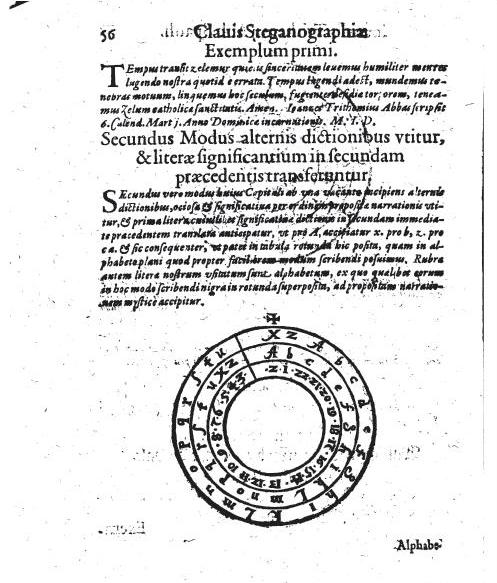
The important page from Polygraphia.

A page from Steganographia.

Another page from Steganographia.

One can understand why Johannes Trithemuis got into trouble.

Ah, boyhood memories.
Now, as I noted already, the importance of Johannes Trithemuis to Golden Dawn is his book, Polygraphia. Both William Wynn Westcott and Kenneth Mackenzie had copies of this book in their libraries. The question is Why? In the case of Mackenzie is was probably more about the codes and ciphers; his pen-name was Cryptonymus and he occasionally refered to his wife as Sister Cryptonyma. In Westcott's case, I lean more toward his interest in the esoteric, including magic. But in all honesty, the answer for both men must be a little bit of ciphers and codes and a little bit of magic. They would be the first...or last...magicians to have an interest in codes and ciphers (both Dee and Agrippa leap to mind).

Yet the existence of the book in both libraries create a trust problem when it comes to the various stories that Westcott told about the Cipher Manuscript. One of the stories says that Mackenzie had seen the Cipher Manuscript and had "expressed ignorance of it and wonder." Yet Mackenzie would have been able to decipher it easily, even without a key---a key, he just happened to have in his own library. And Mackenzie, like Westcott, was a member of many societies and Orders and a collector of esoteric lore. I am not sure that Mackenzie could have expressed ignorance and wonder over the Cipher Manuscript...but that is a subject for another day.

Friday, January 6, 2012

Basics of ciphers and codes

Page from Polygraphia bearing the GD Cipher.
The student at this point of the discussion about the Cipher Manuscript needs to know a few basics about codes and ciphers. In the Bast Temple version of the Zelator (1=10) initiation ritual, the initiate is presented with several examples of codes and ciphers in the additional third part of the ritual.

(The third part of the Bast Temple Zelator ritual is so irregular from the viewpoint of other Golden Dawn Orders. It was inserted into the ritual to allow the ritual introduction of geomancy to occur during the Zelator initiation, rather than forcing the student to wait until Theoricus (2=9) where the traditional Golden Dawn Orders ritually introduce the system to the initiate. To flesh out rest of the third part, several other subjects were also introduced, including codes and ciphers. One of the results of this minor change in the ritual is that Bast Temple students get to study the Neophyte and Zelator sections of the Cipher Manuscript while in Zelator without someone frowning at them about studying material beyond their Grade.)

One of the ciphers presented to the Zelator is "Thee Cipher," the cipher that was used in the foundational (DNA) document of the Golden Dawn---the cipher of the Cipher Manuscript. The cipher dates to before 1518. The source of the cipher for Frater C was probably from Johannes Trithemius' Polygraphia (original edition 1518). The above pictue is the page that the cipher is found on from the 1561 edition.

The text roughly reads in Old French (according to Wikipedia):

Fifth Book.
Another alphabet, by which Honorius, a. k. a. Thebanius occultly describes the rules of magic.
{Theban alphabet cipher}
Another alphabet, by which some alchemists wanted to secretly use & describe rules & secrets of their science; making this science look more estimable than it deserves.
{GD alchemical cipher}
Usually alchemy is accompanied by several servants, familiars and domestics, who...

(Before you ask---no, I do not know how Trithemius finished that sentence.)

Trithemius' Polygraphia was in circulation among the members of fringe masonry in 19th century England (though to what extent is uncertain). Both Kenneth Mackenizie and Wynn Westcott had copies of this book in their libraries. A common assumption is that Frater C was very much into the use of ciphers. This may be true; it is known that Mackenzie (one of the possible creators of the Cipher Manuscript) was rather fond of ciphers. Another common assumption is that because Westcott had a copy of the cipher key, all his stories about how hard it was to "translate" the document are more to impress the listener than actually accurately relay information.

Exactly how hard is it to work with a known cipher?

An message to decipher...if you want to try, that is.
For instance, take this example. It is 58 words and it took me 30 minutes to sketch with a pencil, and another 15 minutes to ink it. So forty-five minutes to encipher a single page.

I am not sure how long it would take someone to decipher it even with the use of the key provided earlier. Frater C modified the symbol for the letter Y, and created a new symbol for the letter W. In my example, two additional symbols were created for the letters J and V. While I made an attempt to make sure that the spaces between one word and the next are clear, I am not so sure that they are completely clear now that I step back and look at the sample. Furthermore, Frater C, like myself in the sample presented, uses Hebrew letters as numbers. My Hebrew letters always get comments from the peanut gallery. Someone who examines my example will also notice that I considered something important enourgh to "write in the clear"---after all, my handwriting is terrible, even without the added burden of writing in a strange alphabet.

During the course of writing up the example, I caught two mistakes as I was engaged in the creation of the sample. These I corrected before inking. How many more I made without noticing will be something that I will learn later. This is important as we will later see when we look at pages from the Cipher Manuscript---mistakes complicate the deciphering process.

Now for those who would like to hear some gooblygook, the Golden Dawn "Thee Cipher" is what is known as a "simple alphabetic substitution script." In other words, the letters of the English alphabet are substituted for symbols, with each symbol only representing a single English letter. There are other forms of ciphers---some that take several steps to encipher and decipher.

You may also like to know that there is a difference between ciphers and codes. Ciphers focus on the letter level of the language. Codes, on the other hand, focus on whole words to attempt to disguise the information context from those who do not have the proper key. It is also probably interesting to the more nerdy readers that given a large enourgh sample in a language that one knows and enourgh brainpower (in the form of people, steam-powered differantial engines, or computers), any code or cipher can be broken. Complicated codes and ciphers merely slow the process down.

Of course, with the Cipher Manuscript, even with a complete cipher key, there are things that will slow the process of reading the document down to a crawl---for more on that, I suggest consulting Carroll "Poke" Runyon's Secrets of the Golden Dawn Cypher Manuscript.

Thursday, January 5, 2012

Cipher Manuscript built in problems

Ok, I think that I am done with the numerous disclosure statements that I have had to issue to make everyone happy---which all basically say that you should not be reading this blog (or any of my writing for that matter) because I am not an expert in their eyes (and I am referring to several parties here---I don't think that I can throw a rock without hitting someone who believes this).

So now, let's turn our attention back to the Cipher Manuscript (there is a post from a few days ago on this subject).

There are a few problems with studying the Cipher Manuscript---some of which have plagued Golden Dawn from its very beginning; others are problems affecting anyone who wants to study the manuscript and its content.

Let's start with the latter type of problem. The biggest problem that affects scholars studying the Cipher Manuscript is that we are forced to study it through "trace copies" and "photocopies." This may or may not be a problem depending upon what you are interested in. If you are only interested in the contexts, then trace copies and photocopies are sufficient for one's purposes. But trace copies and photocopies require one to take a leap of faith about certain things, such as the age of the paper and ink. For instance, the science of determining the age of a manuscript has moved on since the last time that the age of the manuscript was determined.

Now, today we are better off than we were forty years ago. We do have the photocopies and trace copies of the Cipher Manuscript. Previous to the 1970s, no one (or maybe only a few people) in the esoteric community had access to the Cipher Manuscript. The document entered a private collection in 1923, and for all practical purposes disappeared.

The circulation of the Cipher Manuscript, awareness of the actual document and not just the myth of it, seems to have been limited to a small number of people in the original Order. Interestingly enourgh, A. E. Waite seems to had access to its contents through a copy of the document made by W, A. Ayton. Likewise, Frank William Coleman knew of the Cipher Manuscript. I have reason to believe that Aleister Crowley may have had knowledge of its contents, but I have no hard proof to prove my theory. The exact circulation of the contents of the Cipher Manuscript among the membership of the original Golden Dawn is hard to determine based on the currently available information. I feel that is safe to say that study of the Cipher Manuscript by members of the original Order was optional, and probably involved a favor or two in order to be allowed to make a copy of it.

In modern times, the Cipher Manuscript resurfaced. The first person to see it in modern times was Ellic Howe, who gained access to the private collection that used the document since 1923. Howe's conclusions about the Cipher Manuscript was unfavorable to say the least. Interestingly enourgh, Howe seems to ignored some of the pages of the document, or perhaps did not see the whole document. During the 1970s, there were some small press publications of the Cipher Manuscript. It was not until the 1990s that a decent publication of the Cipher Manuscript happened.

Today, the best sources are "The Complete Golden Dawn Cipher Manuscript" (Darcy Kuntz) and "Secrets of the Golden Dawn Cypher Manuscript" (Carroll "Poke" Runyon). There are a couple of websites that host images of the Cipher Manuscript; my preferred favorite is the Golden Dawn Library Project.

A couple of the modern Golden Dawn groups have changed their lesson plans to include the Cipher Manuscript. Hathoor Temple (IIOGD) included it in a limited lesson at the Inner Order level---based on the less-than-stellar 70s publications. BIOGD/BIORC includes a brief lesson about the Cipher Manuscript in Outer Order at the Zelator (1=10) Grade level (limited to the Neophyte and Zelator sections), and a longer lesson at the Inner Order level of Adept Minor Theoricus (5=6 THAM).

Another problem facing the scholar is the fact that various publications of the Cipher Manuscript order the pages of the Cipher Manuscript differently. I am working on a spreadsheet to address this problem (in fact, considering that this is a "prescheduled post," it may actually be done by this point in time). There is the additional problem that there were later additions to the Cipher Manuscript, including pages by Coleman and Westcott. Complicating matters is the fact that the lines of the documents are garbled---in fact, the Cipher Manuscript may be a copy itself of an earlier version.

Unless you have worked at "translating" some of the pages yourself (actually the proper term is "decipher"), one is unaware of the difficulties involved at decoding the mess that the Cipher Manuscript is...in fact, Runyon points out that he understands why several people did not finish the task.

The final problem facing the scholar who is merely studying the content of the document is that the Cipher Manuscript is an outline that refers to information from sources---and one is left trying to figure out the sources without a list in hand. In a future post, I will be discussing this problem in more detail; I am merely mentioning it at this point to remind people that I am aware of the problem.

Now the preceeding list of problems was merely based on the content of the Cipher Manuscript itself. There are also a couple of problems that plague the person trying to put the Cipher Manuscript into its proper context (again, the subject of an upcoming blog post). Briefly, they are "Who wrote the document and why?" and "How did Westcott obtain the document?" Both of these questions have plagued Golden Dawn from the beginning. (And in my case, they have spurred me to issue a set of disclosure statements prior to issuing this series of blog posts...because people hate my conclusions.)

So there you have it, a list of problems that will cause no end of problems when it comes to studying the Cipher Manuscript. You will be seeing these problems rear their ugly heads over and over again as we progress through the Cipher Manuscript.

Monday, January 2, 2012

Cipher Mix

As I noted in yesterday's disclosure update, one of the things that we have learned this past year is that European Third Order cut contact with the Golden Dawn/Alpha and Omega/RR et AC because they learned (though the publishing of the Golden Dawn and Inner Order material by Crowley) that Mathers had gone too far in the blending and mixing of egregores that were never met to be mixed to the extent that the Z documents instructs. (Why they did not know this information sooner is a mystery of occult history.)

Looking over the Cipher Manuscript, the outline of the Outer Order rituals, I can see why Mathers and Westcott thought it was ok to mix egregores and lores. Here is a brief list of all the various systems and egregores that the Cipher Manuscript has in it.

Enochian system of Dee and Kelley [British occultism]
Latin Grade mystic titles [German Rosicrucian]
Signs, passwords and Grade sashes [Freemasonry]
Admission badges [SRIA]
Samothracian Kabric lore
Hebrew, Latin and Greek (besides the Enochian and English) languages
Pillars with Egyptian figures on them [Tablet of Isis or the Book of the Dead]
Eleusinian Mysteries lore [Greek]
Prayer from the Divine Pymander of Hermes Trismegistus [Hermetica]
Grimoric Tradition lore [Medieval and Renaissance occult lore]
The Chaldean Oracles [Zoroaster]
Kamea of the planets/sephiroth
Elemental Prayers [Mathers and Westcott used the same ones that Levi did]
Biblical quotes
Kabbalah [Jewish mysticism]
Christian mysticism
English occult writings
Elemental Pentagram key
System of correspondences
Aesh Mezareph [Christian-Jewish alchemical synthesis]
Laboratory alchemy
Religious alchemy
Philosophical alchemy
Natural alchemy [these last three are mentioned as different things]
Osiris and the three animal forms of Western cardinal signs

I am probably missing a couple---if so, just note the missing ones in the comment section.

Specific examples of blending (both in the Cipher Manuscript and lecture/ritual workups):

Westcott wrote his notes using a mixture of languages and ciphers.

Temple name tradition drew from Freemasonry, Roman and Eygpt lore.

Westcott's official history lecture mentions Eliphaz Levi [French occultism], Kenneth Mackenzie [English Freemasonry and RC] and Frederick Hockley [a crystal gazer].

The Tarot is associated with both Egyptian lore and the Kabbalah. Furthermore, the Tarot is associated with the Hebrew alphabet [Kabbalah] and astrology.

Geomancy is associated with astrology and Tree of Life.

Alchemy is associated with the Tree of Life.

(It is a small step, or mistake if you believe the Third Order, to associate alchemy with geomancy, astrology and the Tarot.)

Perhaps the biggest blending of egregores is the Khabs Am Pekht, Konx Om Pax, Light In Extension, which blends Egyptian, Greek and English mysteries.

And this leads me to the conclusion that either the European Third Order failed to see the potential logical extension trap of their Cipher Manuscript; or that the Cipher Manuscript has nothing to do with the Third Order that Mathers had contact with. Their blaming Mathers for making a logical extension of what was contained in the Cipher Manuscript is much like handing someone a loaded gun and then blaming them for shooting someone. One can only imagine what the Third Order thinks of my own work which includes work with the Norse runes and Reiki, as well as Wiccan mysteries. Needless to say, no one has to worry about the Third Order inviting me into their ranks---I embrace the blending of egregores with far too much gusto.